Weekly Summary

Weekly Global Outlook
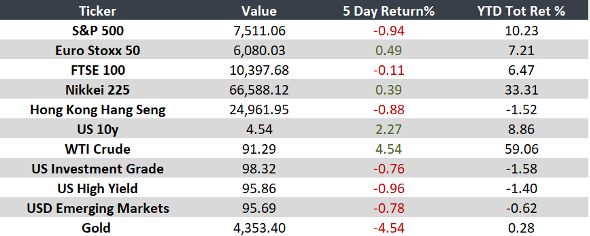
Markets remain resilient despite inflationary pressures and global challenges

The global economy continues to display mixed signals. While the United States remains supported by strong employment and economic activity, Europe faces rising inflationary pressures and Asia presents a contrast between recovering demand and slowing industrial activity. Investors remain focused on the path of interest rates and the performance of corporate earnings.

United States

Markets pulled back after reaching record highs as bond yields moved higher. Employment and economic activity exceeded expectations, while investor appetite for AI and technology infrastructure companies remained strong.

Europe

Eurozone inflation reached 3.2%, driven by higher energy prices. Manufacturing continues to expand modestly, although elevated costs and softer new orders are weighing on momentum.

Japan

Manufacturing and services activity showed signs of slowing. Input costs continue to rise, while both domestic and external demand are gradually losing momentum.

China

Manufacturing growth moderated but exceeded expectations. Services activity posted its strongest performance since February, supported by improving domestic demand.

Argentina

The government will move forward with its application to join the CPTPP, reinforcing its trade liberalization strategy and deeper integration into global markets.

Brazil

Manufacturing activity contracted due to weaker demand and supply-chain disruptions. However, industrial production maintained solid year-over-year growth, highlighting the sector’s resilience.

Mexico

Lower tax revenues are increasing pressure on fiscal deficit targets. Meanwhile, remittances continue to grow, while fixed investment remains on a prolonged weak trend.

“Bull markets are born on pessimism, grow on skepticism, mature on optimism, and die on euphoria.” — Sir John Templeton

KEY UPCOMING EVENTS

  • In the United States, inflation data (CPI) will be released 06/10
  • In the United States, PPI will be released 06/11

Monitor:

Note: Returns as of 10 AM ET.

Rate Cuts: How Close Are We? 

In a holiday-shortened week, U.S. labor data and inflation trends in Latin America took center stage. Expectations around the Federal Reserve’s next move are once again driving market sentiment. 

United States: 

  • Consumer confidence fell to its lowest level since April, and layoffs continued to rise, pushing the probability of a December rate cut to 84%, up from 39% the previous week. 

Europe: 

  • Business confidence in Germany unexpectedly weakened. In the United Kingdom, the new fiscal budget includes tax increases amid an environment of sluggish economic growth. 

Japan: 

  • Prime Minister Sanae Takaichi heightened diplomatic tensions with China after stating that Japan could intervene if Beijing acts against Taiwan, adding uncertainty to the regional outlook. 

China: 

  • Industrial profits fell 5.5% in October, while the government adopted a firmer stance regarding Taiwan, amplifying geopolitical risks across Asia. 

Brazil: 

  • Annual inflation slowed to 4.50% in November, returning to the central bank’s target range for the first time since January—an outcome welcomed by markets. 

Mexico: 

  • Inflation rose to 3.61% in the first half of November. Banxico revised its 2025 growth forecast down from 0.6% to 0.3%, while keeping its 2026 estimate unchanged at 1.1%. 

“The thesis underlying everything, whether you’re an actively managed fund or a passive fund, is that the U.S. will be OK. If you don’t believe that, you shouldn’t be in the stock market.” — Peter Lynch 

Key Upcoming Events: 

  • United States: Second estimate of Q3 2025 GDP and ISM Manufacturing — December 2 
  • United States: ISM Services Index — December 3 

Monitor

Global Outlook: Mixed Signals in Inflation and Employment Amid Divided Fed Stances 

Markets moved through a week of soft economic activity in the U.S. and mixed signals across global regions. Key developments included monetary policy adjustments, moderate growth figures, and relevant updates on inflation and employment. This backdrop underscores the importance of analyzing structural trends, not just short-term market moves. 

  • United States: The agreement to fund the government through January ended the longest shutdown on record, while the Fed showed mixed views on future rate cuts. The technology sector remained volatile amid valuation concerns. 

  • Europe: The U.K. labor market weakened, with unemployment rising to 5.0%—its highest level since 2021. 3Q25 growth slowed, reinforcing expectations for a Bank of England rate cut. The eurozone economy continued to expand at a modest pace in the third quarter. 

  • Japan: The Bank of Japan reiterated that it aims for moderate inflation supported by wage growth and improving economic conditions, in line with the government’s broader growth strategy. 

  • China: Producer prices fell 2.1% year over year—less than expected—while consumer inflation rose 0.2%, reversing two months of declines. Industrial production and retail sales also delivered weak readings. 

  • Brazil: Monthly inflation rose 0.09%, helped by lower electricity tariffs, while the annual figure dropped to 4.68%. The central bank is preparing additional regulations to address the increase in cyberattacks. 

  • Mexico: Industrial activity fell 3.3% in September, marking seven consecutive months of contraction. Banxico expects inflation to converge to 3% by 3Q26 and anticipates only limited impact from new taxes. 

“We don’t prognosticate macroeconomic factors; we’re looking at our companies from a bottom-up perspective on their long-run prospects of returning.” – Mellody Hobson 

Key Upcoming Events:  

  • United States: Industrial production – 11/18. 
  • United States: Federal Reserve minutes – 11/19. 

Monitor

Perspectivas económicas: Decisiones clave y sus impactos globales.

En lo que va del año, las economías globales muestran señales mixtas: 

Estados Unidos: La Fed mantuvo la tasa de referencia en 4.25%-4.5%, mientras el PIB del 4T24 creció un 2.3%, moderando su avance respecto a trimestres previos. 

Europa: El BCE recortó la tasa de referencia a 2.75%, en un contexto de estancamiento económico en la zona euro. 

China: La actividad manufacturera y los servicios se contrajeron inesperadamente, fortaleciendo expectativas de nuevos estímulos. 

México: Las exportaciones crecieron un 4.1% anual en 2024, mientras que el PIB del 4T24 cayó un 0.6%, su primera contracción desde 2021. 

Te invitamos a analizar estos datos y sus implicaciones para tus decisiones financieras y estratégicas. Si deseas más información o un análisis detallado, no dudes en contactarnos. 


Eventos Importantes en las Próximas Semanas 

  • En Estados Unidos, se conocerá el ISM de manufactura 02/03 
  • En Estados Unidos, tendremos datos del empleo 02/07 

Monitor 

Ponte en contacto con nosotros

Recibe las mejores noticias del mercado financiero

Política de cookies

Utilizamos cookies propias y de terceros para mejorar nuestros servicios y mostrarte publicidad relacionada con tus preferencias, mediante el análisis de tus hábitos de navegación. Al continuar, confirmas que has leído y aceptas dicha Política.