
Markets focused on inflation and geopolitical risks
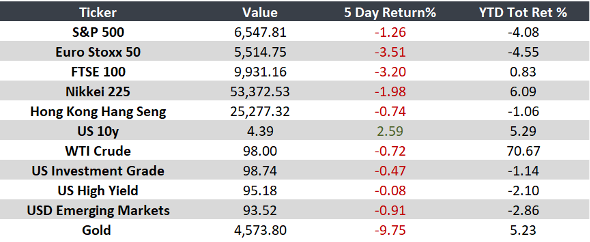
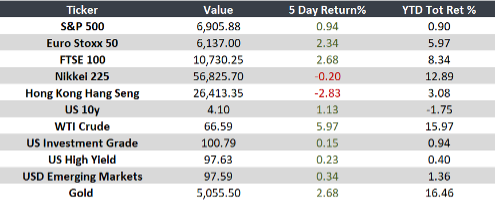
Week of March 16–20 Financial markets remained volatile amid ongoing inflationary pressures and geopolitical risks. Monetary policy decisions and economic data continue to shape expectations for global growth. United States The Fed kept rates unchanged at 3.5%–3.75% amid persistent inflation and rising energy prices. It also eased bank capital rules, while the PPI surprised to […]
Energy-driven volatility and mixed inflation signals shape global markets this week.
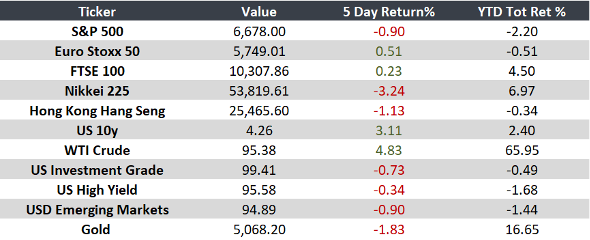
Week of March 9–13 Markets are navigating geopolitical tensions, energy pressures, and diverging economic signals. While inflation is moderating in some economies, growth prospects and monetary policy remain influenced by ongoing global uncertainty. United StatesVolatility increased amid Middle East tensions and rising oil prices. Inflation held at 2.4%, while the trade deficit narrowed following record […]
Weekly Economic Outlook: Risks and Resilience
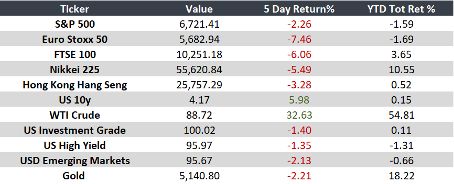
Week of March 2–6 The week delivered a diverse economic outlook: weaker employment and consumer data in the U.S., signs of industrial recovery in Europe and Asia, and structural adjustments alongside moderate growth prospects in Latin America. United States Nonfarm payrolls fell by 92,000 in February and the unemployment rate rose to 4.4%, largely due […]
Markets Navigate Policy and Growth Signals
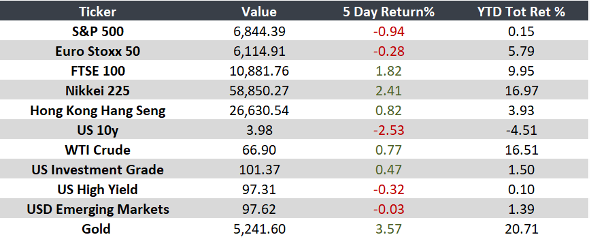
Week of February 23–27 Markets are balancing solid earnings, evolving trade policy, and diverging inflation trends across regions. While growth remains resilient in some economies, policy uncertainty and valuation levels continue to guide investor positioning. United States The Supreme Court struck down “emergency” tariffs due to lack of Congressional approval. The Administration introduced a new […]
Moderate Growth and Mixed Signals
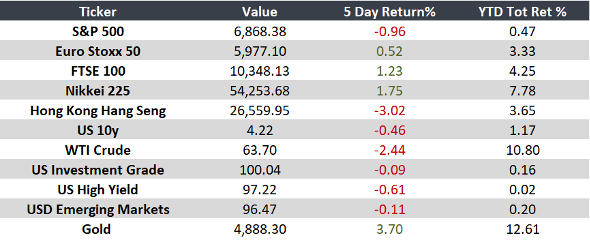
Week of February 16–20 The week brought signs of slowing growth in the U.S., persistent inflation pressures in Europe, and ongoing adjustments across Asia and Latin America. Markets remain focused on inflation, interest rates, and geopolitical risks. United States Q4 2025 GDP grew 1.4%, below expectations, impacted by the government shutdown. The Fed maintained a […]
Weekly global macro outlook

February 9–13 The global economy continues to show moderate growth, with inflation easing in developed markets while emerging markets face more persistent pressures. Central banks remain focused on stability and monitoring macro risks. United StatesEmployment surprised to the upside and inflation continues to moderate, giving the Fed room to keep rates steady. Corporate earnings remain […]
Mixed signals in employment, inflation, and global activity
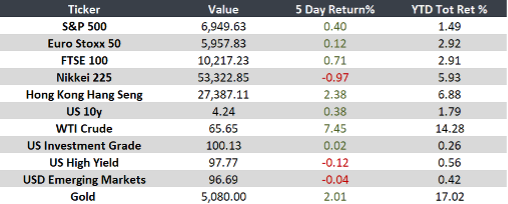
Week of February 2 – 6 The week delivered mixed signals: strong corporate earnings resilience in the U.S., moderating inflation in Europe, and some slowdown across parts of LatAm, while Asia shows early signs of stabilization in industrial activity. United States Private job growth slowed, but manufacturing and services remain resilient. Earnings season remains strong, […]
Global outlook: inflation, growth, and trade
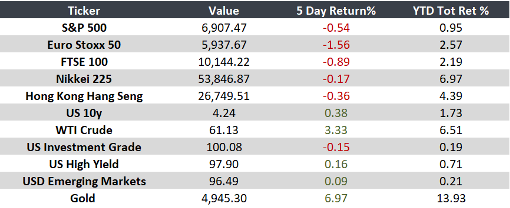
Week of January 26 to 30 Global markets reflect a balance between solid growth in developed economies, persistent inflationary pressures in certain sectors, and ongoing monetary policy adjustments in emerging markets. United States The Fed kept rates at 3.5%–3.75% amid solid growth and stable employment. PPI rose 0.5% month on month, and the trade deficit widened in November, potentially weighing […]
Global outlook: growth and inflation in focus
Week of January 19–23 Global markets reflect a balance between resilient growth, easing inflation in some regions, and persistent pressures in others, shaping monetary policy expectations and economic activity in 2025. United States Q3 GDP was revised up to a 4.4% annualized rate, driven by exports, business investment, and strong consumer spending. The Federal Reserve is expected to keep rates at 3.50%–3.75% this quarter, reflecting a cautious stance amid mixed economic data. Europe Eurozone inflation closed 2025 at 1.9%, below the European Central Bank’s 2% target. Germany’s economic confidence improved after several difficult quarters, while the United Kingdom continues to face persistent inflation pressures that complicate monetary policy decisions. Japan Inflation eased to 2.1% year over year in December. Lower energy prices offset underlying pressures, although core inflation remains above the Bank of Japan’s target, maintaining uncertainty about future monetary adjustments. China GDP grew 4.5% in the fourth quarter, weighed down significantly by the real estate sector. Weak consumption contrasts with a late-year rebound in industrial production, reflecting an uneven economic landscape that requires targeted stimulus measures. Argentina Economic activity fell 0.3% year over year in November, its first contraction in 14 months, despite solid performance in agriculture and mining sectors. The economy shows signs of weakness in other key sectors. Brazil Business confidence improved slightly but remains in pessimistic territory. Concerns persist about the pace of the domestic economic recovery, with worries about sustained medium-term growth. Mexico Inflation rose in the first half of the year, while consumption remained strong, supported by higher retail sales and e-commerce growth. The consumer dynamics contrast with moderation in other economic indicators. Key upcoming events “The big money is not in the buying and selling, but in the waiting.” – Charlie Munger Monitor
Mixed outlook between inflation and growth
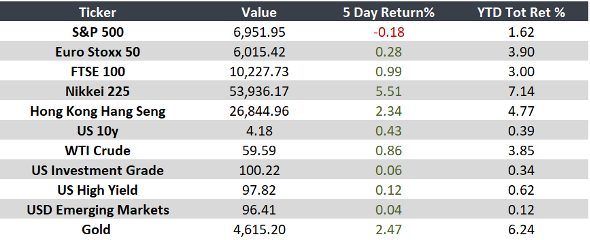
Week of January 12–16 Key data on inflation, consumption, and growth shape the start of 2026 This week, markets reacted to mixed signals: stable U.S. inflation, positive surprises in retail sales, and uneven growth across Europe. Meanwhile, China strengthened its global trade presence, and Argentina closed the year with its lowest inflation in eight years. United States Headline inflation held at 2.7% and core inflation at 2.6%. PPI rebounded to 3% due to energy. Retail sales rose 0.6%, pointing to a segmented consumption pattern. Projected GDP was revised to 5.1%. The earnings season begins with positive results from banks. Europe Germany exits recession with 0.2% annual growth, though industrial activity remains weak. The United Kingdom surprised with 1.4% annual growth. Trade association BGA expects a modest recovery in Germany’s wholesale sector in 2026. Japan The prime minister will dissolve Parliament and call early elections. The Producer Price Index fell to 2.4% year over year in December, the lowest level since May, in line with expectations. China Posted a record trade surplus of $1.19 trillion in 2025. The decline in exports to the U.S. was offset by strong growth in shipments to Africa and Asia. Argentina Inflation closed the year at 31.5%, its lowest level since 2017. In December, prices rose 2.8%, driven by transportation, housing, and food. Brazil Retail sales increased 1.3% year over year in November. While positive, they remain below the historical average. Mexico The World Bank lowered its 2026 growth forecast to 1.3%. Fixed investment fell 5.5% year over year in October, although residential construction grew 13.5%. Key upcoming events “The stock market is a device for transferring money from the impatient to the patient.” – Warren Buffett Monitor
