Escalation in the Middle East and Markets
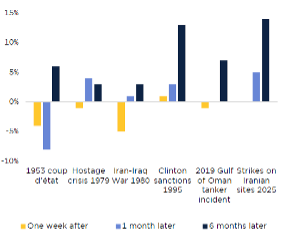
The United States and Israel launched airstrikes in Iran, marking an escalation that heightens global geopolitical tensions. Brent crude and gold moved higher following the attacks. While the conflict could increase short-term volatility, the current consensus is that there will be no prolonged disruption to global energy supply.
Markets will remain focused on the Strait of Hormuz, through which roughly 20% of the world’s oil and gas flows, as well as on Iran’s response.
Analysis
Historically, geopolitical shocks tend to generate short-lived episodes of volatility unless they evolve into broader economic disruptions. At this stage, the central scenario points to a limited impact on global energy supply.
In this environment, maintaining discipline, diversification, and a long-term perspective remains key to managing risks and capturing opportunities.
Historical context
History shows that geopolitical shocks often translate into short-term volatility, but not necessarily into lasting economic damage. The performance of the S&P 500 during previous conflicts in the Gulf countries confirms this pattern.
Source: Bloomberg, Edmond de Rothschild

