admin

Inflation Steps Back, Markets Move Forward

his week’s U.S. inflation data gave markets exactly what they were looking for: confirmation that monetary policy could remain on hold in the near term.


U.S. inflation moderated as expected during the week of August 10–14, pushing major equity indices to new all-time highs. This reinforces the soft-landing narrative and reduces pressure on the Federal Reserve to act in the near term.


Beyond the U.S. border, the global picture offered important nuances. Europe showed resilience with solid second-quarter growth in both the U.K. and the Eurozone, while Asia continued to deliver mixed signals: Japan sees producer prices gradually easing, and China faces weak domestic demand despite moderating inflation. In Latin America, Brazil reported inflation within the central bank’s target range and solid consumer spending, while Mexico continues to navigate U.S. tariff pressure on its automotive sector, even as broader industrial activity surprised to the upside.


For investors, this week’s environment reinforces a risk-on posture, with equity markets leading the optimism. However, attention will need to shift to the Jackson Hole Symposium, where the Fed may deliver key signals about its monetary policy roadmap. Any tone more hawkish than expected could reverse some of the recent gains.

Monitor
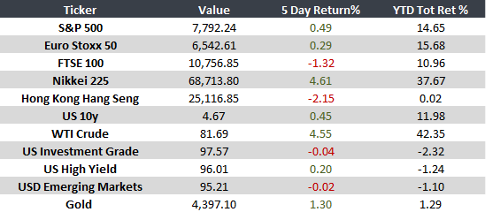

Source: Macroeconomic data for the week of August 10–14, 2026.
Inflation 

July inflation eased, reducing pressure on the Federal Reserve. Markets strengthen expectations that interest rates will remain unchanged.

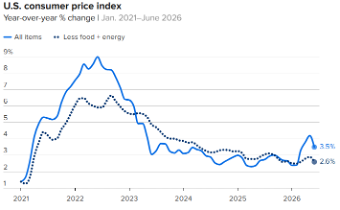
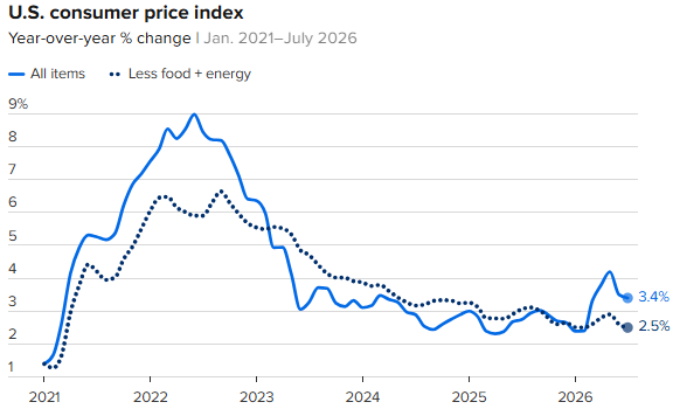
Inflation in the United States showed further signs of easing in July. The Consumer Price Index (CPI) rose 0.1% month over month and 3.4% year over year, in line with market expectations, while core inflation came in at 2.5% annually. These results reinforced expectations that the Federal Reserve will keep interest rates unchanged at its September meeting, although the final decision will continue to depend on upcoming economic data.

Cooling inflation has eased the immediate pressure on the Federal Reserve and provided greater certainty for financial markets. However, inflation remains above the Fed’s 2% target, and factors such as energy costs and housing inflation could continue to contribute to market volatility. Upcoming inflation reports will be critical in shaping the path of monetary policy.

Monitor

Source: U.S. Bureau of Labor Statistics

Global Weekly Outlook 

Labor market softens while artificial intelligence continues to fuel corporate growth.

Markets navigated a week of mixed signals. While the U.S. labor market slowed more than expected, manufacturing activity and earnings season continued to benefit from investment in artificial intelligence. At the same time, Europe maintained moderate growth, Asia remained supported by trade, and Latin America continued to navigate a cautious monetary policy environment.

Employment came in weaker than expected, reinforcing expectations that the Fed will keep interest rates unchanged. Manufacturing activity and corporate earnings continue to show strength, driven by investment in artificial intelligence.

Producer price inflation continued to moderate, although consumer demand remained weak. Manufacturing showed modest improvement, supported by stronger exports and easing input costs.

Manufacturing recorded its seventh consecutive month of expansion, with the strongest production growth since 2014, fueled by robust AI-related demand.

Exports remained strong, supported by technology and AI-related demand, while manufacturing activity moderated, pointing to more balanced economic growth.

The renewal of the currency swap agreement with China strengthens external liquidity and provides additional financial support for bilateral trade.

The central bank lowered its benchmark interest rate while maintaining a cautious stance on inflation. Industrial activity continues to show signs of slowing.

Banxico kept its benchmark interest rate unchanged. Public investment and remittances continue to support economic activity despite ongoing global uncertainty.

“To earn the highest of returns that are realistically possible, you should invest with simplicity.”
— John Bogle

Upcoming events

  • In the United States, inflation data will be released 08/12
  • In the United States, PPI data will be released on 08/13

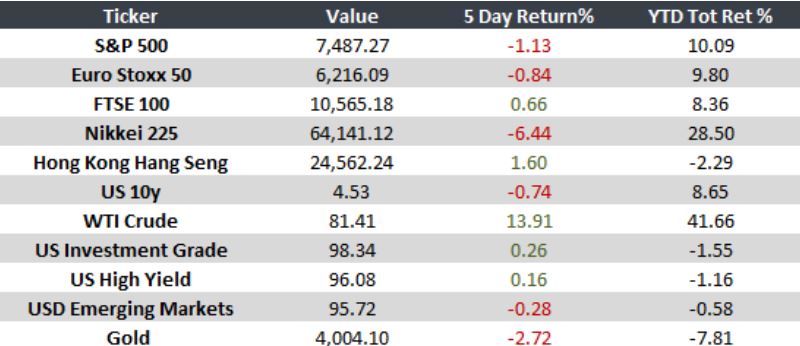
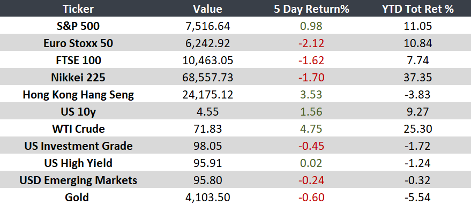
Market Monitor

Indicative prices as of 10:00 AM EST

Elections

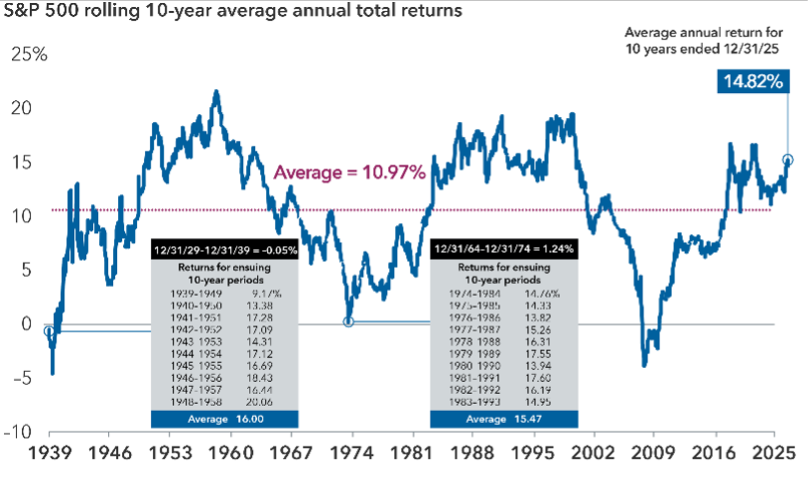
Election years often bring volatility—but also opportunities. History shows that market volatility is often temporary.

U.S. midterm elections have historically been associated with heightened uncertainty and increased market volatility. During these election years, the S&P 500 has typically posted more subdued returns as investors adopt a more cautious stance. However, once the election outcome becomes clear, markets have generally regained momentum. Since 1950, the S&P 500 has delivered an average 15.4% return in the 12 months following a midterm election—nearly double the average return recorded during other years.

While election cycles can influence short-term market sentiment, economic fundamentals remain the primary driver of long-term investment returns. Corporate earnings growth, monetary policy, and overall economic activity have historically had a much greater impact than election outcomes. For investors, maintaining a disciplined investment strategy and avoiding emotional decisions during periods of volatility has consistently proven to be more effective than attempting to time the market.

Monitor

Source: Capital Group

Corrections

Market declines are part of investing; disciplined reactions can make the difference. Keys to staying on course when markets decline.

Market declines are inevitable and often lead to impulsive decisions. However, history shows that corrections have been temporary and followed by recoveries. Maintaining a defined strategy, diversifying, and avoiding attempts to anticipate every market move can help protect long-term goals. Rather than eliminating volatility, the challenge is to manage it with perspective and discipline.

Time in the market is often more important than finding the perfect entry point. Leaving the market may mean missing some of the strongest recovery days. A diversified portfolio, including fixed income and regular contributions, can reduce volatility and support more rational decisions. During downturns, staying committed to the plan is often more effective than reacting to market noise.

Monitor

Source: Capital Group, Morningstar, RIMES, S&P.

Weekly Global Outlook 

Lower inflation, corporate earnings, and uneven growth signals shaped the week.

Markets assessed the start of earnings season alongside easing inflation in the United States. However, geopolitical tensions and weaker activity and investment continue to create an uneven global economic environment.

  • Inflation eased and the labor market remained resilient. Early corporate earnings exceeded expectations, although technology-sector volatility and geopolitical tensions weighed on markets.

  • Eurozone inflation continued to decline, but industrial production remained weak. The United Kingdom posted moderate growth, supported by the services sector.

  • Industrial production edged higher during the month but declined year over year due to weakness in machinery, pointing to a still-fragile recovery.

  • GDP growth slowed due to weak consumer spending and lower investment. Exports rebounded strongly, supported by demand related to artificial intelligence.

  • Annual inflation increased, although the monthly pace moderated. Tourism, housing, and regulated services continued to drive price pressures.

  • Retail sales and the services sector posted limited growth. Weakness in transportation confirmed a moderate economic activity environment.

  • Formal employment and manufacturing payrolls continued to weaken, while private consumption remained resilient, supported by real wage growth, remittances, and low unemployment.

“Investing is the intersection of economics and psychology.”
— Phil Town

KEY UPCOMING EVENTS

  • In the United States, employment related data will be released 07/21
  • In the United States, manufacturing PMI will be released on 07/24

Monitor:

Note: Returns as of 10 AM ET.

Inflation

Lower energy prices eased inflation, but risks remain. Inflation slowed more than expected in June.

Inflation in the United States surprised to the downside in June, easing to 3.5% year over year, down from 4.2% in May and below the 3.8% consensus forecast. On a monthly basis, the Consumer Price Index (CPI) declined 0.4%, marking its largest monthly drop since April 2020, driven primarily by lower energy prices. Meanwhile, core inflation eased to 2.6% year over year, also coming in below expectations. While these figures provide some relief for consumers and financial markets, the Federal Reserve will continue assessing whether this moderation proves sustainable.

The moderation in inflation eases the immediate pressure on the Federal Reserve, but it does not yet guarantee a shift in the path of interest rates. The 5.7% monthly decline in energy prices was the primary driver behind the improvement, while core inflation remained stable. Oil prices and developments in the Middle East conflict will be key factors in determining whether this trend can continue.

Source: U.S. Bureau of Labor Statistics

Global Weekly Outlook 

Markets combined lower volatility with mixed signals on growth and inflation.

Markets remained relatively stable, although challenges related to inflation, international trade, and monetary policy persist. While the United States and Europe continue to show resilience across several indicators, Asia and Latin America face more specific economic headwinds.

  • Markets posted modest gains despite continued volatility in oil prices. The Fed remains firmly data-dependent, while the trade deficit widened and services activity continued to lose momentum.

  • Consumer spending continues to recover and Germany’s external trade improved. However, higher producer prices indicate that inflationary pressures have not fully subsided.

  • Producer price inflation remains elevated, although the monthly pace of increase moderated, suggesting a gradual easing in cost pressures.

  • Consumer inflation continued to soften, while producer prices posted their strongest increase in several years, reflecting rising costs across the industrial sector.

  • The government is seeking to secure debt financing through domestic and multilateral sources, prioritizing lower borrowing costs before returning to international capital markets.

  • Inflation continued to moderate thanks to lower food and housing costs, although energy prices remain a significant source of inflationary pressure.

  • Inflation fell to its lowest level since 2020, while investment showed signs of recovery. However, uncertainty surrounding trade relations with the United States continues to weigh on the automotive sector.

“It’s not how much money you make, but how much money you keep, how hard it works for you, and how many generations you keep it for.”

— Robert Kiyosaki

Key Upcoming Events

  • In the United States, June inflation data will be released 07/14
  • In the United States, June PPI will be released 07/15

Monitor:

Note: Returns as of 10 AM ET

Earnings Season 

Technology leads revisions as markets anticipate another double-digit earnings quarter. Corporate earnings continue to surprise to the upside.

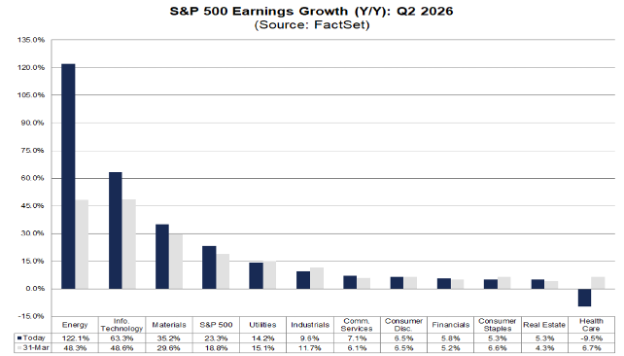
The second-quarter earnings season begins with stronger-than-usual expectations. Following a first quarter in which nearly 85% of S&P 500 companies exceeded earnings estimates, analysts have revised their Q2 forecasts upward, an uncommon trend at this stage of the quarter. Currently, S&P 500 earnings are expected to grow by more than 23% year over year in Q2, while revenue is projected to increase by more than 12%, driven primarily by the energy and technology sectors. Looking ahead, consensus expectations call for approximately 24.1% earnings growth for full-year 2026.

Corporate earnings growth continues to be led by the technology sector, where earnings revisions and positive corporate guidance have reached multi-year highs. While other sectors, such as energy, benefited during the second quarter from higher oil prices, digitalization, artificial intelligence, and demand for technology infrastructure have become the primary drivers of margin expansion and profit growth across the U.S. equity market.

Source: FactSet

Weekly Global Overview 

Global growth continues to show mixed signals between resilient consumption and moderating economic activity.

Markets entered July with lighter trading activity due to the U.S. Independence Day holiday, while economic indicators pointed to a gradual slowdown in global growth. Consumption remains resilient across several regions, although challenges related to trade, manufacturing, and industrial activity persist.

United States

  • Markets ended the week on a positive note despite signs of moderation in labor markets and manufacturing activity. Consumption remains solid, although the trade deficit reached its highest level in more than a year.

Europe

  • Inflation continues to moderate thanks to lower energy costs. Consumption remains resilient, although signs of industrial weakness and slower growth in the United Kingdom persist.

Japan

  • Retail sales surprised to the upside, supported by wage growth, while industrial production continues a gradual, albeit fragile, recovery.

China

  • The manufacturing PMI recorded its third consecutive month of expansion, driven by technology exports and artificial intelligence-related demand, despite weak domestic consumption.

Argentina

  • Economic activity continues to post positive annual growth, albeit at a slower pace, supported by agriculture and mining.

Brazil

  • Producer prices faced less pressure due to lower food and mining costs, partially offsetting increases in other industrial sectors.

Mexico

  • Manufacturing activity and remittances continue to support economic growth, while concerns over trade and tax revenue collection are increasing.

“Compound interest is the eighth wonder of the world. He who understands it, earns it. He who doesn’t, pays it.” — Albert Einstein

KEY UPCOMING EVENTS

  • In the United States, the Services PMI will be released on 07/06
  • In the United States, employment-related data will be released on 07/09

Monitor:

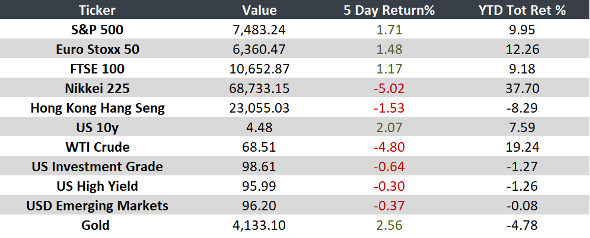
Note: Returns as of July 2 at closing

Ponte en contacto con nosotros

Receive the best financial market news

Cookie Policy

We use our own and third party cookies to improve our services and show you advertising related to your preferences, by analyzing your browsing habits. By continuing, you confirm that you have read and accept this policy.