Uriel Loredo

Fed cuts again but remains cautious

The Federal Reserve delivered its second rate cut of the year, lowering the policy rate by 25 bps to a range of 3.75%–4%. It announced that it will halt its balance sheet reduction in December. 

The Fed acknowledged moderate growth but warned of rising labor market risks.  The vote was 10–2, reflecting divided positions. 


Powell: another cut in December is not guaranteed. 

Key Data: 

  • Second rate cut of 2025 
  • Rate range: 3.75%–4% 
  • Vote: 10–2 
  • Balance sheet runoff to end in December 
  • Labor market risks on the rise 


The market continues to expect a possible third rate cut in December, though signals remain mixed. 
The Fed remains cautious and data-dependent, with employment as a key variable guiding the rate path. 
Global Outlook: Mixed Signals and Market Caution

Week: October 13–17 

Markets showed a mix of recovery signs and new challenges, driven by trade tensions, monetary policy decisions, and corporate earnings. 

United States 

  • Tensions with China escalated following new statements from President Trump. 
  • Chair Powell suggested the end of the tightening cycle, opening the door to potential rate cuts. 
  • Banks reported solid earnings, though volatility persists among regional banks. 

Europe 

  • German investor confidence rose less than expected. 
  • The U.K. economy grew 0.1% in August, but with downward revisions to prior data. 
  • The IMF urged the Bank of England to remain cautious, as inflation is expected to stay the highest in the G7. 

Asia 

  • In China, exports rose 8.3% year-over-year in September, the fastest pace in six months. 
  • Inflation fell again (-0.3%), reflecting weak domestic demand and ongoing trade tensions. 
  • Producer prices dropped 2.3% annually. 

Latin America 

  • In Brazil, the economy expanded 0.4% in August, below expectations. Analysts expect a deeper slowdown as monetary policy remains tight. The Central Bank maintained its benchmark rate at 15%. 
  • In Mexico, the IMF projects a fiscal deficit of 3.9% of GDP for 2025 — the highest since 2000. The government is assessing potential tariff adjustments for 2026, depending on U.S.–China trade developments. 

“Risk comes from not knowing what you are doing.” — Warren Buffett 

Key Upcoming Events: 

  • China: GDP, industrial production, and retail sales data — October 20 
  • United States: Consumer prices and new home sales — October 24 

Monitor: 

U.S. Government Shutdown: Political Uncertainty, Market Resilience 

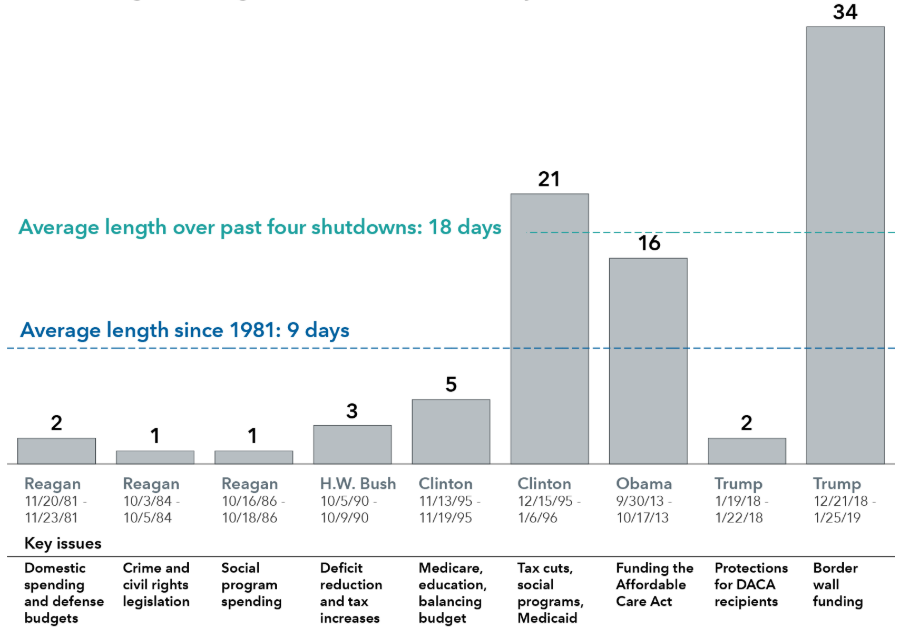
The U.S. government shutdown is once again testing market patience amid stalled negotiations and disagreements over public spending. Unlike previous shutdowns, this time there is talk of permanent layoffs instead of temporary furloughs, which could have a stronger impact on employment and domestic consumption. However, historical evidence suggests that such events tend to have a limited effect on financial asset performance over the medium and long term. The main market drivers remain fundamentals: inflation, interest rates, earnings, and employment. 

Key Data: 

  • Average government shutdown duration: 9 days 
  • Longest shutdown: 34 days (2018–2019) 
  • Potential permanent layoffs could have longer-lasting effects 

The key is to stay focused, avoid hasty decisions, and rely on diversification as protection against political noise. 

Source: Capital Group  

Week of Uncertainty in the U.S. and Surprises in Asia 

Markets opened October with mixed signals. Attention focused on the ongoing U.S. government shutdown, revised growth forecasts in China and Mexico, and stronger trade performance in Brazil. In Asia, Japan saw a historic political shift with the election of Sanae Takaichi as leader of the ruling party, while Europe faced renewed political instability. 

United States: 

  • The government shutdown remains unresolved. 
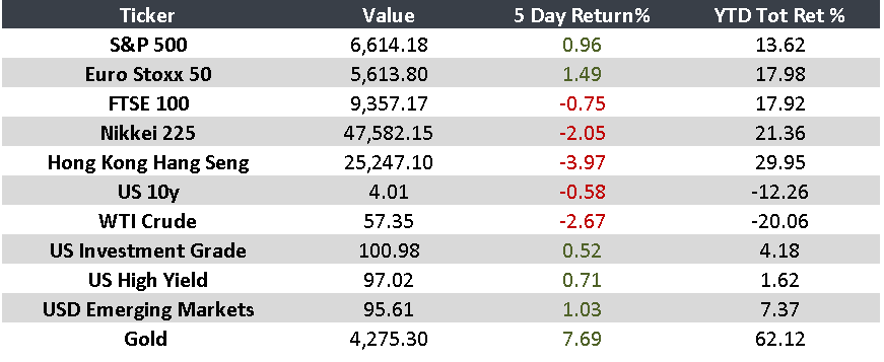
  • Gold surpassed $4,000 amid political and fiscal uncertainty. 
  • The Fed signaled openness to rate cuts, though doubts persist about their extent. 

Europe: 

  • France faced an unexpected resignation from its prime minister. 
  • In Germany, exports and factory orders fell. 
  • The government raised its 2024 growth forecast to 0.2%. 

Asia: 

  • In Japan, Sanae Takaichi was elected leader of the ruling party, positioning her to become the country’s first female prime minister. 
  • In China, despite the holiday break, the World Bank raised its growth forecast to 4.8%, and the government tightened export controls on rare earth minerals. 

Latin America: 

  • In Brazil, beef exports to China rose 38.3% year-over-year in September, setting a new trade record. 
  • In Mexico, inflation rose to 3.76% in September. The World Bank revised its 2025 growth forecast upward to 0.5% and anticipates 1.4% for 2026. 

“The four most dangerous words in investing are: ‘This time it’s different.’” — John Templeton 

Key Upcoming Events: 

  • China: Export and inflation data — October 12–15 
  • United States: Inflation report — October 15 

Monitor

Key Market Moves | Weekly Summary

General Summary: Markets faced mixed signals last week, balancing political uncertainty in the U.S., inflationary pressures in Europe, and weakness in Asia. Meanwhile, Latin America showed resilience in public finances and corporate outlooks.

United States

  • The government remains shut down, the first in nearly seven years, delaying official labor data. Still, markets closed higher on optimism for a short shutdown and strong tech sector performance.
  • ADP reported a reduction of 32,000 jobs in September, the largest decline since March 2023.
  • Consumer confidence fell more than expected, while President Trump announced an agreement with Pfizer to voluntarily lower drug prices.

Europe

  • UK GDP slowed to 0.3% in Q2 (vs. 0.7% in Q1), in line with expectations.
  • German inflation accelerated to 2.4% YoY, the highest since February, while unemployment rose by 14,000 to 2.98M.
  • The European Union plans to double steel tariffs to 50%, aligning with the U.S. against Chinese overcapacity.

Asia

  • Japan: Industrial production fell 1.2% MoM, while retail sales dropped 1.1%, the first contraction in over three years.
  • China: Manufacturing activity contracted for the sixth consecutive month, awaiting new stimulus measures and clearer U.S. trade relations.

Latin America

  • Brazil: Public finances exceeded expectations; debt held at 77.5% of GDP, and the primary deficit was ~BRL 17B (~USD 3B), lower than projected.
  • Mexico: Fitch plans to raise Pemex’s rating from BB to BB+ after a USD 10B bond buyback, highlighting closer ties with the sovereign. The government emphasized economic resilience and projects 2.3% average growth in 2026.

“In investing, what is comfortable is rarely profitable.” — Robert Arnott

Important Events:

  • U.S.: Fed officials’ speeches — October 7–10
  • U.S.: Fed minutes — October 8

Monitor

S&P 500 Earnings Outlook — 3Q 2025

The S&P 500 shows resilience heading into 3Q 2025, with reasonable earnings growth expectations despite a challenging macroeconomic backdrop. Below are the main takeaways for the upcoming earnings season: 

Earnings Growth 

  • Earnings (EPS) are projected to grow 7.9% YoY in 3Q 2025. If confirmed, this would mark the ninth consecutive quarter of growth for the S&P 500. As of June 30, the growth estimate stood at 7.3%
  • Six sectors have seen upward revisions to estimates, contributing to stronger earnings expectations. 

Sector Growth 

  • Eight of the eleven sectors are projected to post annual growth, led by Information Technology, Utilities, Materials, and Financials
  • Three sectors are expected to report annual declines, mainly Energy and Consumer Staples

Revenues 

  • Revenues are expected to grow 6.3% YoY, compared to the 4.8% projection as of June 30
  • If confirmed: 
    o This would be the second-largest revenue growth since 3Q 2022 (11.0%), only behind the previous quarter. 
    o It would mark the 20th consecutive quarter of revenue growth for the index. 

Valuation 

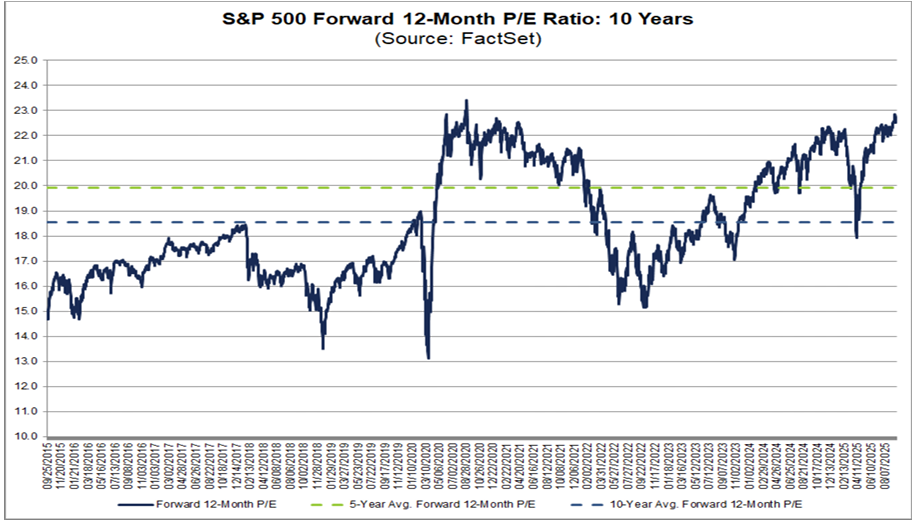
  • The S&P 500 forward 12-month P/E multiple stands at ~22.5x, above the 5-year average (19.9x) and the 10-year average (18.6x). 
  • This suggests that while earnings growth continues, valuations remain tight with much optimism already priced in

Key data points for the quarter: 
☑ EPS growth estimate +7.9% YoY in 3Q 2025 (vs. 7.3% as of June 30) 
☑ Six sectors with upward revisions 
☑ 8 of 11 sectors projected to grow 
☑ Revenues +6.3% YoY (vs. 4.8% as of June 30) 
☑ 20th consecutive quarter of revenue growth 
☑ Forward 12-month P/E ~22.5x (vs. 19.9x 5-year avg. and 18.6x 10-year avg.) 

Corporate performance remains resilient, with earnings growth expectations of 10.8% in 2025 and 13.8% in 2026 — outlooks that investors will closely monitor in a context of valuations above historical averages. 

Source: FactSet 

Global Economic Outlook: Mixed Signals and Upward Revision

General Summary: In an environment marked by monetary uncertainty and resilient consumption, the latest data and comments from financial authorities show a mixed picture: while the OECD revised global growth forecasts upward, some central banks remain cautious and highlight medium-term risks.

United States

  • Fed Governor Stephen Miran stated that interest rates are too high and should be cut by up to 200 bps.
  • Jerome Powell warned that equity valuations remain elevated and the path to rate cuts is uncertain.
  • Q2 GDP was revised upward to 3.8% annualized, supported by consumer spending.
  • OECD projects global growth of 3.2% in 2024 and 1.8% for the U.S. in 2025.

Europe

  • UK retail sales rose 0.5% in August.
  • Eurozone business activity reached its fastest pace in 16 months, led by Germany’s service sector.
  • The Swiss National Bank held rates at 0% and warned about the potential impact of U.S. tariffs through 2026.

Japan

  • Manufacturing contracted at the sharpest pace in six months.
  • The services producer price index rose 2.7% YoY in August.

China

  • Donald Trump advanced plans for U.S. investors to acquire TikTok’s U.S. operations from ByteDance, valued at $14 billion.

Mexico

  • Banxico cut the policy rate to 7.5%, the lowest level in three years.
  • Inflation in the first half of September stood at 3.74% YoY, in line with expectations.
  • OECD revised growth to 0.8% in 2024 (from 0.4%) and to 1.3% in 2026 (from 1.1%).

“The greatest enemy of a good plan is the dream of a perfect plan. Stick to the good plan.” — John C. Bogle

Key Events:

  • U.S.: Consumer Confidence — September 30
  • U.S.: Employment Report — October 03

Monitor

Central Banks Set the Tone for the Week

Recent economic data and monetary policy decisions highlight diverging dynamics in the global landscape. From the Fed’s first rate cut of the year to slowing momentum in China and persistent inflation in the United Kingdom, markets are navigating a complex environment. 

United States: 

  • In the United States, the Federal Reserve delivered its first rate cut of the year, while retail sales surprised to the upside. 

Europe: 

  • In the United Kingdom the inflation remained elevated. 
  • In Germany  investor´s confidence improved unexpectedly. 

Asia: 

  • China showed a slowdown in consumption and industry. 
  • Japan recorded a sharp drop in exports to the U.S. 

Latin America: 

  • Brazil kept its benchmark rate unchanged. 
  • Mexico advanced with USMCA consultations and issued bonds to finance PEMEX. 

“I’ve usually used the phrase stay the course as one of the great rules of investment success.” — John C. Bogle 

Key Upcoming Events 

  • In the United States, several Fed members are scheduled to speak — 09/22–24 
  • In the United States, the final revision of Q2 2025 GDP will be released — 09/25 

Monitor

Fed cuts rates for the first time in 2025, cautious outlook

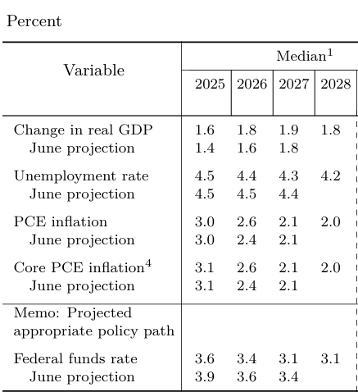
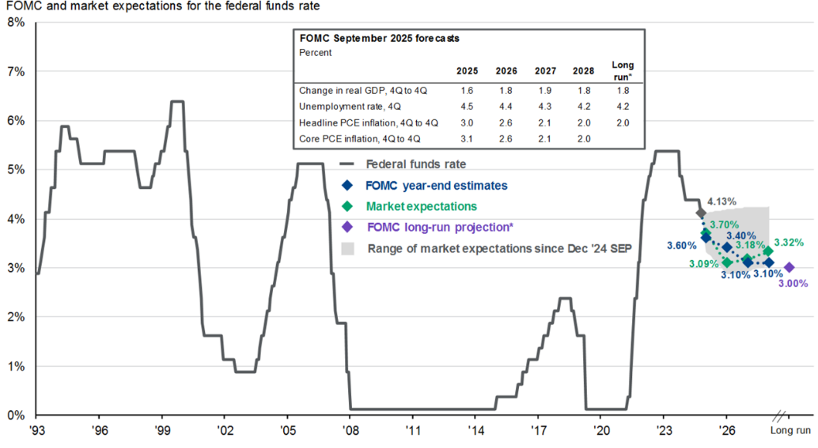
The Federal Reserve lowered its benchmark rate to a 4.00%–4.25% range, in line with expectations. The decision was nearly unanimous, with only one dissent. Projections point to two additional cuts before year-end, which would bring the average rate to 3.6%.  

For 2026, the Fed anticipates just one more adjustment. While inflation and unemployment forecasts remained unchanged, Jerome Powell acknowledged a substantial slowdown in labor demand and job creation. 

The Fed confirms a policy shift but with caution. The bias remains restrictive: only three cuts are projected through 2026. Markets will closely monitor upcoming inflation and employment data. 

FED Indicators Update (September vs. June)

Source: Federal Reserve.

Market Outlook and Positioning

The stability of inflation and weakness in employment have raised expectations for a more accommodative monetary environment. Combined with the trade agreements reached so far and easing tensions with China, this has boosted investor optimism. 

Here’s a summary of key developments: 

Market Performance 
After a challenging first half of the year, the S&P 500 and Nasdaq have posted double-digit gains year-to-date. 

Valuation 
The S&P 500’s valuation remains high, with a forward P/E of approximately 22x. 

Strategy and Positioning 
While the corporate environment could gain momentum from fiscal and monetary stimulus, we maintain a neutral tactical stance on Large Cap equities. 

Key Events to Watch 

  • Employment trends and potential interest rate cuts. 
  • Corporate earnings growth as the year draws to a close. 
Ponte en contacto con nosotros

Receive the best financial market news

Cookie Policy

We use our own and third party cookies to improve our services and show you advertising related to your preferences, by analyzing your browsing habits. By continuing, you confirm that you have read and accept this policy.