Uriel Loredo

Software and Liquidity in Private Credit

PIK exposure remains stable at 6.6%, reflecting the structural flexibility characteristic of private credit. The portfolio maintains a meaningful allocation to software, historically the sector with the lowest default rates due to high margins, low capex, and recurring revenue.

PIK and structural flexibility

Liquid (traded) loans should not have PIKs. PE sponsors seek capital flexibility and access — that’s a key value driver of private credit.

PIK is a form of flexibility — more common in private credit, not applicable in public markets. Bain, for example, does not offer PIK flexibility — they lend to significantly smaller businesses than BCRED’s target market.

PIK is a form of flexibility — reserved for private credit, absent in public markets. Bain: no PIKs, but their borrowers are significantly smaller than BCRED’s portfolio companies.

Software as a defensive sector

Software: historically the lowest default sector in private credit — driven by low capex, high margins, and recurring revenue. Attractive sector for capital deployment.

98% first lien. Focus on scale businesses: ~$360mm average EBITDA. ~$4bn average total enterprise value per portfolio company. Healthy businesses.

Lowest default sector over the past 20 years — key rationale for the overweight.

Artificial intelligence risk

On AI risk to software: Jensen Huang’s view — people will be more efficient, but enterprises won’t rebuild core software in-house. AI is a tool, not a replacement for existing software companies that hold patents and deep integrations (e.g., no one is rebuilding Dropbox).

Underwriting process: before any investment, Blackstone’s tech team (based in Miami) evaluates the business, and then consults multiple Blackstone PE teams — if the PE teams would not invest in the equity, Blackstone will not lend to the company.

Largest software positions include cybersecurity. Not all software is the same — Blackstone categorizes by AI exposure and risk profile.

Of the ~26% software allocation, only ~5% is considered at risk from AI disruption. Meaningful headwinds identified; currently marked at ~88 cents on the dollar.

Worst-case scenario (100% default, recovery at 75 cents on the dollar): ~30bps drawdown to NAV.

Liquidity and maturities

Average remaining loan maturity: 3–5 years (~4 years average). Contract lengths align with loan maturities — provides visibility into repayment.

12–15% of the loan book matures this year; capital is also being deployed, maintaining strong liquidity. New capital being deployed in parallel — active recycling. A lot of liquidity.

Currently underlevered; target is 1:1 leverage ratio.

BCRED holds the highest credit rating of any private credit fund globally.

Source: Internal Research AWM
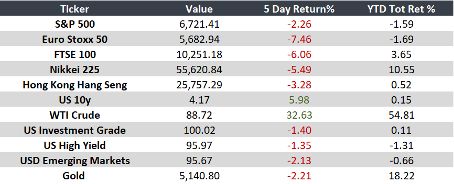
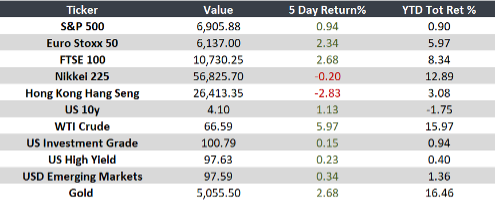
Energy-driven volatility and mixed inflation signals shape global markets this week.

Markets are navigating geopolitical tensions, energy pressures, and diverging economic signals. While inflation is moderating in some economies, growth prospects and monetary policy remain influenced by ongoing global uncertainty.

United States
Volatility increased amid Middle East tensions and rising oil prices. Inflation held at 2.4%, while the trade deficit narrowed following record exports. Jobless claims declined, suggesting the labor market remains resilient.

Europe
German inflation eased to 1.9%, though core inflation remains elevated. Industrial production and exports declined. The ECB warned of inflation risks linked to higher oil prices, signaling a potentially less accommodative policy stance.

Japan
GDP grew 1.3% in 2025, driven by stronger investment and consumption. Producer inflation moderated to 2.0%, pointing to some stabilization in industrial costs.

China
Inflation rose to 1.3% due to Lunar New Year spending. Exports surged 21.8% in the first two months of the year, generating a large trade surplus supported by manufacturing and technology sectors.

Argentina
Inflation increased to 33.2% in February. Despite the monthly rise, it remains well below the country’s historical average, reflecting progress in macroeconomic stabilization.

Brazil
Annual inflation slowed to 3.81%, although monthly inflation rose due to seasonal factors. Retail sales grew 2.8% year-over-year, indicating resilient consumer demand.

Mexico
Inflation rose to 4.02%, with core inflation remaining elevated, potentially delaying interest rate cuts. The USMCA review and energy price dynamics will be key themes. Authorities agreed to keep regular gasoline prices stable.

“If you aren’t willing to own a stock for 10 years, don’t even think about owning it for 10 minutes.”

– Warren BuffettForma

KEY UPCOMING EVENTS

  • In the United States, industrial production data will be released on 03/16.
  • In the United States, the FEDs monetary policy decision will be released on 03/18.

Monitor

Returns as of 10 AM EST.

Start Simple: A Core-First Approach to Alternative Investing

The alternative investments world is growing fast, but so is the confusion around how to approach it. I’ve seen investors jump into alts with ambitious, exotic bets—venture funds, crypto hedge funds, distressed debt specials—before building a core foundation. That’s rarely a good idea.

Just like you don’t start fixed income investing with high-yield EM debt, you shouldn’t start private markets with the alts equivalent of rocket fuel.

The Reality of First Steps

In my experience at both a pension fund and now a family office, the most effective portfolios I’ve seen didn’t begin with what’s flashy. They began with what’s durable.

When we started building our alternatives allocation at the family office, we didn’t begin by chasing alpha through frontier VC. We started with private credit. It was relatively “boring” on the surface—but that was exactly the point.

Too often, “alts” are pitched as the high-octane portion of a portfolio. And while that can be true in later stages, the first goal should be building a base layer that complements traditional exposures with income, resilience, and true diversification.

Education Before Complexity

The knowledge gap in alternatives is real. I’ve seen smart advisors with excellent public market skills struggle with the structural nuances of alts: capital calls, valuation lags, illiquidity profiles, GP selection, waterfall mechanics.

That’s not a knock—these concepts aren’t intuitive unless you’ve worked with them.

That’s why I firmly believe alternative investing should follow the same logic we use in public markets: start with what you can explain clearly to yourself and your stakeholders.

In fixed income, that might be treasuries. In equities, the S&P 500. In alternatives, the equivalents are:

  • Private credit with solid underwriting and short to medium-term maturities
  • Core/core-plus real estate for income and inflation sensitivity
  • Broad-based private equity buyout funds with seasoned managers

These are not “exciting” stories to pitch. But they are strategies that provide yield, stability, and learning opportunities. Importantly, they help the allocator (and the governance body) get familiar with alts mechanics before layering complexity.

A Practical Progression

I think of alts entry as a “training wheels” stage—not because investors are unsophisticated, but because the mechanics and manager dispersion in private markets are different.

Here’s how we think about sequencing exposure:

  1. Private Credit – First for predictable income, shorter duration, and underwriting clarity
  2. Private Equity – Then for growth and compounding over long cycles
  3. Real Assets – Infrastructure and real estate offer inflation hedges and tangible anchors
  4. Hedge Funds – For strategic diversification, but only with clarity on strategy fit
  5. Venture – The aggressive play
  6. Anything and everything else – Special situations, crypto, sector niches

We followed this sequence at the family office and it allowed the IC and broader team to gain confidence with each layer before adding the next. It also avoided the performance and governance headaches that can come from leaping into illiquid, idiosyncratic deals too early.

Alts are powerful, but they’re not magic. Like any asset class, their success in a portfolio depends on how well they’re understood, implemented, and managed. The danger lies in starting with “alpha” before mastering “beta.”

So, before going all-in on that new AI-focused VC strategy or that complex special situations fund, ask: Have we built the right foundation?

Because when the next downturn hits—or when liquidity is needed—boring may just become beautiful.

Source: AWM Internal Analysis

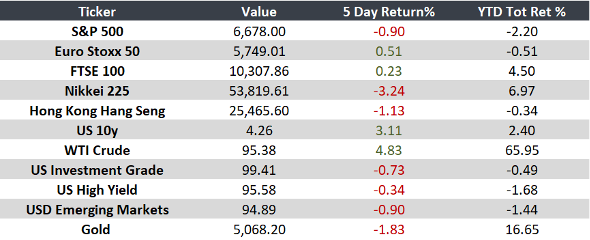
Weekly Economic Outlook: Risks and Resilience 

The week delivered a diverse economic outlook: weaker employment and consumer data in the U.S., signs of industrial recovery in Europe and Asia, and structural adjustments alongside moderate growth prospects in Latin America.

United States

Nonfarm payrolls fell by 92,000 in February and the unemployment rate rose to 4.4%, largely due to temporary factors. Consumer activity also softened, while rising cost pressures in manufacturing and services increased inflation risks.

Europe

In the U.K., construction fell to its lowest level in 14 months, although manufacturing expanded on stronger external demand. In Germany, both manufacturing and services grew in February, supported by orders and stimulus despite higher costs.

Japan

Unemployment rose to 2.7% in January, signaling a cooling labor market. In contrast, the manufacturing PMI reached its highest level in nearly four years, supported by exports, new orders, and stronger business optimism.

China

Economic activity accelerated in February, with both manufacturing and services PMIs exceeding expectations thanks to exports and job creation, although business optimism softened due to rising costs.

Argentina

The government announced it will prioritize a comprehensive tax reform in 2026 aimed at reducing the tax burden to support growth, alongside changes to the electoral and criminal frameworks.

Brazil

The economy grew 2.3% in 2025, its slowest pace since the pandemic. A weak year-end performance strengthens expectations for interest rate cuts in 2026.

Mexico

Remittances fell 1.4% year over year in January, the first decline for that month since 2015. Although investment rebounded at the end of 2025, the year closed in contraction. Analysts raised the 2026 growth forecast to 1.46%.

“If a business does well, the stock eventually follows.” – Warren Buffett

Key upcoming events

  • In the United States, employment related data will be released on 03/10
  • In the United States, February’s inflation data will be released on 03/11

Monitor

Escalation in the Middle East and Markets

The United States and Israel launched airstrikes in Iran, marking an escalation that heightens global geopolitical tensions. Brent crude and gold moved higher following the attacks. While the conflict could increase short-term volatility, the current consensus is that there will be no prolonged disruption to global energy supply.

Markets will remain focused on the Strait of Hormuz, through which roughly 20% of the world’s oil and gas flows, as well as on Iran’s response.

Analysis

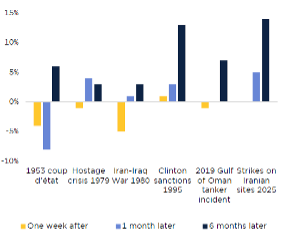
Historically, geopolitical shocks tend to generate short-lived episodes of volatility unless they evolve into broader economic disruptions. At this stage, the central scenario points to a limited impact on global energy supply.

In this environment, maintaining discipline, diversification, and a long-term perspective remains key to managing risks and capturing opportunities.

Historical context

History shows that geopolitical shocks often translate into short-term volatility, but not necessarily into lasting economic damage. The performance of the S&P 500 during previous conflicts in the Gulf countries confirms this pattern.

Source: Bloomberg, Edmond de Rothschild

Markets Navigate Policy and Growth Signals

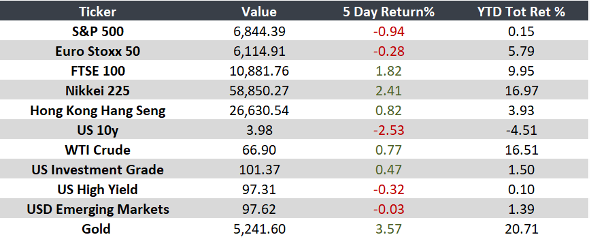
Markets are balancing solid earnings, evolving trade policy, and diverging inflation trends across regions. While growth remains resilient in some economies, policy uncertainty and valuation levels continue to guide investor positioning.

United States

The Supreme Court struck down “emergency” tariffs due to lack of Congressional approval. The Administration introduced a new 10% global tariff. PPI rose 0.5% in January, core at 3.6%. Earnings remain strong, while jobless claims suggest a steady labor market and a Fed on hold.

Europe

Eurozone inflation eased to 1.7%, below the ECB target range, with core at 2.2%. Germany’s inflation moderated to 1.9%, though services remain elevated. Business confidence improved, but consumer sentiment softened amid geopolitical uncertainty.

Japan

The leading economic index reached its highest level since May 2024, supported by labor strength. Services inflation rose 2.6%, reflecting wage pressures. Consumer sentiment weakened due to higher costs and interest rates.

China

The IMF urged China to shift toward consumption-led growth and reduce industrial subsidies, aiming to address external imbalances following record trade surpluses.

Argentina

Economic activity rose 3.5% year-over-year, led by agriculture and mining. Retail sales increased 16.1% nominally, though real consumption declined due to inflation pressures.

Brazil

Brazil posted a primary surplus below expectations, as spending growth outpaced revenue gains, adding pressure to fiscal balance targets.

Mexico

Inflation rose to 3.92% in early February, with core easing slightly. Economic activity expanded 3.3% in December, but unemployment increased to 2.7%, with over 700,000 jobs lost in January.

“Buy a stock the way you would buy a house. Understand and like it such that you’d be content to own it in the absence of any market.” – Warren Buffett

Key upcoming events

  • In the United States, manufacturing PMI will be released on 03/02
  • In the United States, nonfarm payrolls will be released on 03/05

Monitor

Growth cools; inflation persists


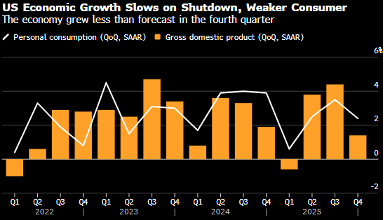
The U.S. economy grew at a 1.4% annualized rate in the fourth quarter of 2025, below expectations, as the government shutdown weighed on spending and exports. For the full year, growth came in at 2.2%, down from 2.8% in 2024.

Meanwhile, core inflation rose to 3% year over year in December, remaining above the Federal Reserve’s target.

Private demand analysis

Although the headline GDP figure was weak, private demand showed resilience: final sales to private domestic purchasers increased 2.4% and private investment rose 3.8%. The main drag came from federal government spending.

With inflation still elevated, the Fed is likely to maintain a cautious stance before considering further rate cuts.

Implications

At the same time, core inflation reached 3%, still above the Federal Reserve’s target. While the headline growth figure was soft, private demand and investment showed resilience. The overall backdrop suggests the Fed will remain cautious in the months ahead.

Source: Bureau of Economic Analysis, Bloomberg

Moderate Growth and Mixed Signals

The week brought signs of slowing growth in the U.S., persistent inflation pressures in Europe, and ongoing adjustments across Asia and Latin America. Markets remain focused on inflation, interest rates, and geopolitical risks.

United States

Q4 2025 GDP grew 1.4%, below expectations, impacted by the government shutdown. The Fed maintained a restrictive tone amid persistent inflation and rising oil prices driven by tensions with Iran.

Europe

Germany posted 2.1% inflation and weaker investor confidence. In the U.K., inflation eased to 3.0%, but unemployment rose to 5.2%, reinforcing expectations of a potential rate cut.

Japan

The economy grew 0.2% in 2025, below forecasts. Inflation moderated, while exports surged 16.8%, narrowing the trade deficit.

China

State-owned enterprises are set to acquire real estate projects to reduce excess supply and stabilize the property market, potentially easing economic headwinds.

Argentina

A trade surplus is projected for January, supported by stronger exports and lower imports, reinforcing the Central Bank’s reserve accumulation.

Brazil

Economic activity expanded 2.5% in 2025, driven by the agricultural sector. The environment remains shaped by restrictive interest rates aimed at containing inflation.

Mexico

Manufacturing employment declined 2% in 2025. Banxico is evaluating potential rate adjustments amid 3.77% inflation, while Fitch warned of challenges to the 2026–2030 infrastructure plan.

“The longer you can extend your time horizon the less competitive the game becomes.” – Howard Marks

Key upcoming events

  • In the United States, employment-related data will be released on 02/24
  • In the United States, Producer Price Index (PPI) inflation data will be released on 02/27

Monitor

A Practical Taxonomy of Alternative Investments 

Understanding the Diversity of Alternatives: From Real Estate to Crypto

One of the most common questions I get from new team members or family principals is deceptively simple: “What exactly do you mean by alternatives?”

It’s a fair question. “Alts” is a broad label that covers everything from core real estate to crypto tokens.

But in my experience—both at a pension fund and now at a family office—how you classify and organize the alt universe shapes how you build, manage, and ultimately compound capital through it.

At AWM, we use a framework that breaks the space into ten categories: private equity, private debt, real estate, infrastructure, venture capital, hedge funds, secondaries, crypto, co-investments, and direct deals. It’s not perfect, but it’s practical—and it helps ensure we stay thoughtful about the role each bucket plays.

Core Categories: Income, Inflation Protection, and Growth

Private equity and venture capital are the long-term growth engines. PE focuses on improving mature businesses, often over 5–10 years, while VC backs early-stage, high-upside companies. Both are illiquid, high-risk, and long-duration—but also the best shot at accessing true alpha from private markets. They don’t generate regular income, and inflation protection is indirect, but they’re crucial for long-run compounding.

Private debt, on the other hand, is more about steady income. Direct lending, real estate credit, and asset-backed strategies can offer attractive yields, especially when structured with floating rates—which can help when inflation and rates are rising. But credit selection and downside protection become even more critical in downturns.

Real estate and infrastructure are classic “real assets.” They tend to shine during inflationary periods because rents, tariffs, and replacement costs rise with prices. Income streams are often contracted and predictable. Infrastructure—especially in regulated utilities, transport, and digital infra—offers particularly bond-like cash flows, but with the added benefit of tangible asset backing.

Strategy-Oriented Exposures and Portfolio Tools

Hedge funds are more about strategy than asset class. Some seek diversification through macro or market-neutral exposures. Others focus on yield via credit or arbitrage. In my pension fund days, we leaned on certain macro and quant managers for downside protection when rates and equities were both challenged. But dispersion is wide, and fees can erode value quickly without tight underwriting.

Secondaries are a portfolio construction tool. They offer accelerated deployment, discounted entry, and vintage diversification—especially helpful when building a new program. They’re not a direct inflation hedge, but they provide flexibility and cash flow smoothing, which helps in overall planning.

Co-investments and direct deals are where concentrated views meet deep alignment. In our framework, they sit on top of a primary-led core, and we only pursue them after years of building GP relationships and in-house diligence capabilities. They can enhance returns, especially when done with low fees and strong control, but they require more time, judgment, and risk management.

Emerging Exposures and the Role of Crypto

Cryptocurrencies are firmly in the alt category now. We treat crypto as a satellite position—small, high risk, and with a very different return driver. Bitcoin may be “digital gold” in theory, but in practice its behavior has varied across regimes. For us, crypto is less about inflation hedging and more about optionality on new infrastructure and asset paradigms. It’s not core, but it’s worth understanding.

Pulling It All Together

This classification helps us design portfolios where:

  • Core real assets and private credit deliver income and inflation resilience
  • Growth strategies like PE, VC, and directs aim for long-term capital appreciation
  • Tools like secondaries and co-invests improve pacing and net returns
  • Satellites like hedge funds and crypto add diversification and idiosyncratic upside

The Takeaway

In alternatives, how you organize matters almost as much as what you invest in. A clear, working taxonomy makes better decisions easier: where to lean in, where to stay cautious, and how to sequence capability development. That’s what turns a collection of deals into a real portfolio.

Source: AWM Internal Analysis

Weekly global macro outlook

The global economy continues to show moderate growth, with inflation easing in developed markets while emerging markets face more persistent pressures. Central banks remain focused on stability and monitoring macro risks.


United States
Employment surprised to the upside and inflation continues to moderate, giving the Fed room to keep rates steady. Corporate earnings remain strong, with solid profit growth and a high share of positive earnings surprises.


Europe
The eurozone posted moderate growth, led by Ireland and Spain. The U.K. continues to show weak growth but early signs of housing recovery, while policymakers focus on strengthening regional competitiveness.


Japan
Corporate bankruptcies reached a 13-year high due to rising labor costs and worker shortages, particularly impacting SMEs, amid weak real wage growth.


China
Low inflation and persistent deflationary pressure reinforce expectations for additional stimulus. Structural weakness in the real estate sector continues.


Argentina
Inflation accelerated again, driven by food and services, maintaining pressure on purchasing power and macro expectations.


Brazil
Inflation rose due to housing and transportation, while producer prices remain in a deflationary trend, reflecting easing upstream cost pressures.


Mexico
Core inflation remains elevated, led by services. Industrial activity shows moderate recovery, while the auto sector faces external trade pressures.

Ponte en contacto con nosotros

Receive the best financial market news

Cookie Policy

We use our own and third party cookies to improve our services and show you advertising related to your preferences, by analyzing your browsing habits. By continuing, you confirm that you have read and accept this policy.