Uriel Loredo

Markets: Lower Volatility, Mixed Signals

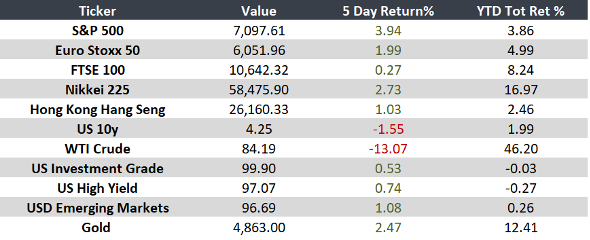
Lower volatility, persistent inflation, and mixed growth signals shaped the week.

Markets experienced lower volatility amid expectations of easing geopolitical tensions. However, inflationary pressures persist alongside mixed growth signals across both developed and emerging economies.

United States

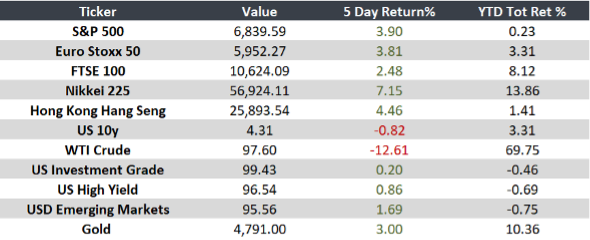
Lower volatility and the S&P 500 reached record highs. Moderate producer inflation and a resilient labor market support a growth environment with contained pressures.

Europe

Inflation rises due to energy, while industrial activity remains weak. The UK stands out with growth driven by services and construction.

Japan

Production grows marginally, and the BoJ may accelerate rate hikes. Slower growth is expected in the coming years.

China

Solid GDP growth, but mixed signals in consumption and employment point to an uneven recovery.

Argentina

Inflation remains elevated despite slight moderation, reflecting ongoing macroeconomic pressures.

Brazil

Consumption slows and industrial confidence declines, signaling deterioration in economic activity.

Mexico

Inflation pressures lead to price control measures. Trade risks rise amid potential changes to USMCA rules.

“Patience is not passive; it is concentrated strength.” – Bruce Lee

Key upcoming events

  • Retail sales data to be released on April 21
  • Employment-related data to be released on April 23

Monitor
Inflation Rises on Energy 

Energy pressures drive inflation higher

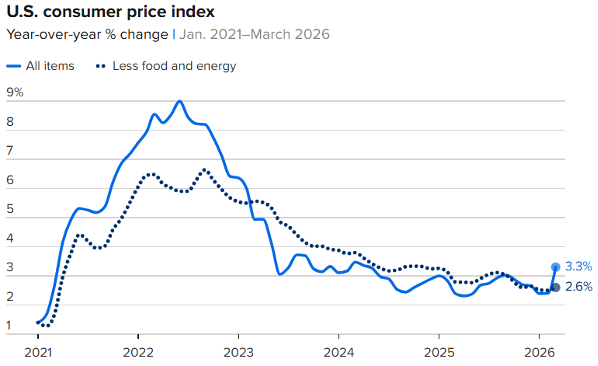
Inflation in the United States rose in March, driven by higher energy prices amid geopolitical tensions. However, core inflation showed greater stability, indicating that underlying inflationary pressures remain contained. This dynamic highlights an environment where short-term movements may distort the broader picture, while the underlying trend remains the primary focus for monetary policy.

The recent inflation increase is largely driven by external and transitory factors. The moderation in core inflation suggests that structural pressures have not intensified. In this context, the Fed may remain patient, focusing on the broader inflation trend beyond temporary shocks, with particular attention to services and labor market conditions.

Source: U.S. Bureau of Labor Statistics

Markets: inflation, energy, and mixed signals

Inflation, energy dynamics, and geopolitical tensions shape the global markets outlook.

Markets are navigating a complex environment, with inflationary pressures tied to energy and ongoing geopolitical tensions weighing on growth prospects. The U.S. shows mixed signals, while Europe and emerging markets reflect slowing activity.

United States

Inflation rises on energy and the services PMI declines amid cost pressures. GDP is revised lower. The Fed keeps rate cuts on the table should inflation moderate or labor market conditions soften.

Europe

Producer inflation slows and consumption remains resilient. However, industrial orders and production in Germany point to economic stagnation.

Japan

Producer prices increase due to higher operating costs, reflecting pressure across industrial and transportation sectors.

China

Consumer inflation moderates, but producer prices rise driven by energy and raw materials, highlighting persistent cost pressures.

Argentina

Industrial production declines sharply across most sectors, reflecting broad-based economic weakness.

Brazil

Inflation rises, driven by fuel and food prices, amid global energy pressures.

Mexico

Inflation remains elevated and Banxico projects gradual convergence. Investment declines amid uncertainty and tight financial conditions.

“The longer you can extend your time horizon the less competitive the game becomes.” – Howard Marks

Key upcoming events

  • In the United States, the Producer Price Index (PPI) will be released on 04/14
  • In the United States, Industrial Production data will be released on 04/16

Monitor

Private Equity: Key Concepts

A simple guide to understand this asset class

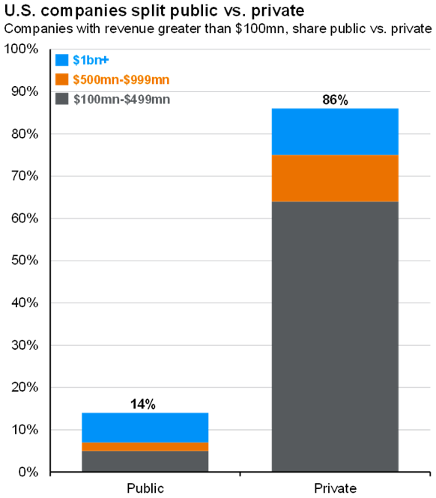
Private equity involves investing in companies that are not publicly listed, with the goal of improving their value and exiting the investment over time. These investments typically have longer horizons and depend on factors such as operational growth, market conditions, and exit opportunities. Unlike public markets, capital is deployed gradually, and returns are realized over time, requiring patience and discipline from investors.

Performance in private equity can vary significantly across managers, making manager selection critical. Factors such as exit execution, access to opportunities, and investment discipline directly impact outcomes. In addition, market cycles, interest rates, and liquidity conditions influence the pace of investment and exits within this asset class.

Source: Jp Morgan

Markets: Inflation, Oil, and Slowdown

Inflation, energy dynamics, and mixed growth signals shaped global markets.

Markets reflect a complex environment, with inflationary pressures, geopolitical-driven volatility, and mixed growth signals. The U.S. remains resilient, while Europe faces higher costs and emerging markets show signs of slowdown.

United States

A quieter week, but with mixed signals: solid consumption, softer labor momentum, and rising cost pressures. Recession risk increases amid higher oil prices and tensions with Iran.

Europe

Inflation rises driven by energy and remains above the ECB target. Unemployment is stable, but job creation slows. The UK shows moderate growth.

Japan

Stable labor market, but weak consumption. Retail sales decline despite fiscal support, highlighting fragile domestic demand.

China

Manufacturing PMI improves, supported by public spending and AI demand, though input cost pressures remain elevated.

Argentina

Labor reform partially halted by court intervention, increasing regulatory uncertainty.

Brazil

Decline in producer prices suggests easing inflationary pressures ahead, supporting expectations of price stability.

Mexico

Banxico nears the end of its rate-cutting cycle. Risks persist from low growth and elevated inflation, with weak economic activity and exports.

“The two greatest enemies of the equity fund investor are expenses and emotions.” – Jhon Bogle

Key upcoming events

  • In the United States, Manufacturing PMI will be released on 04/06
  • In the United States, March inflation data will be released on 04/10

Monitor

Note: Short week due to festivities.

Volatility: Navigating Uncertain Markets

Discipline and perspective in times of uncertainty

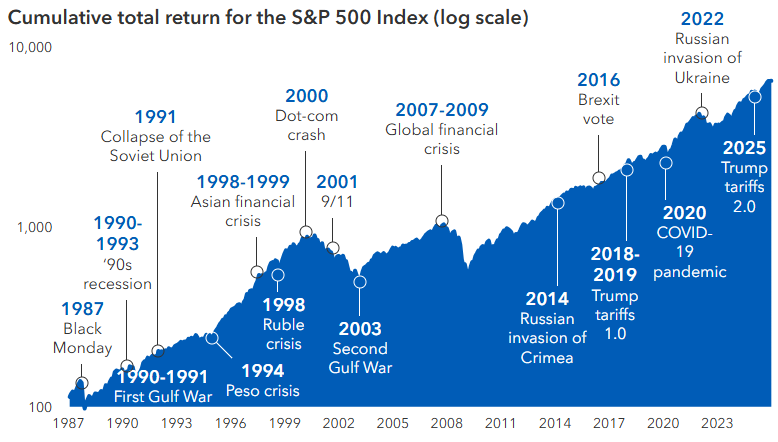
Periods of volatility are a natural part of markets. While they create uncertainty, they also highlight the importance of maintaining discipline. In these environments, it is essential to recognize our reactions, put events into perspective, and stay focused on long-term objectives.

History shows that despite recurring crises, markets have remained resilient. Avoiding impulsive decisions and maintaining consistency in strategy often matters more than reacting to short-term movements.

Volatility can create opportunities, but it requires focus. Beyond short-term noise, it is a good time to revisit objectives, evaluate gradual adjustments, and consider strategies such as rebalancing or phased investing. In many cases, the best decision is to stay the course. Consistency, rather than market timing, has historically been the primary driver of long-term portfolio value.

Source: Capital Group, Standard & Poor’s

Global Outlook: Inflation, Rates, and Conflict

Markets faced a week marked by geopolitical tensions and inflationary pressures. While the U.S. shows labor market resilience, Europe and Japan present mixed signals, and emerging markets like Mexico face challenges in growth and inflation.

United States

Negotiations with Iran remain stalled despite a temporary truce. Manufacturing PMI hits an 11-month low; rising import prices reinforce expectations of higher-for-longer interest rates.

Europe

Manufacturing PMI improves, but the conflict increases costs and delays inputs. Business confidence declines amid uncertainty, particularly impacting the services sector.

Japan

Inflation falls below the BoJ target, but the central bank adopts a more hawkish tone amid inflation risks linked to a weaker yen and geopolitical tensions.

China

The semiconductor industry gains momentum driven by AI. It is projected to reach 41% of global capacity in key chips for autos and smartphones by 2028.

Argentina

Economic activity expands, supported by agriculture and fishing, offsetting weakness in industrial and commercial sectors.

Brazil

Consumer confidence improves, driven by better household financial expectations, though current conditions remain weak.

Mexico

Banxico cuts rates to 6.75% in a split decision. Inflation rises and economic activity declines, pointing to a slowdown with ongoing inflationary pressures.

“Everyone has the brainpower to make money in stocks. Not everyone has the stomach.” – Peter Lynch

Key upcoming events

  • In the United States, employment data will be released on 03/31
  • In the United States, nonfarm payrolls will be released on 04/03

Monitor

Holistic Due Diligence Is a Must

Due diligence isn’t just about validating performance metrics or checking boxes on operational risk. In alternatives—where relationships are long-term, structures are complex, and outcomes are path-dependent—successful DD must be holistic. It needs to reflect the full scope of what you’re signing up for: financial, operational, reputational, philosophical, and relational.

In our experience—both at a pension fund and now at a family office—some of the worst outcomes stemmed not from flawed models, but from poor alignment and blind spots outside the “investment” lens.

Investment quality is just the start

Investment DD will always be the anchor. Track record, strategy clarity, team pedigree, edge, and portfolio construction matter. But in alts, that’s the easy part. Most managers we meet know how to tell a good story, show a clean IRR, and present a polished deck. The real work starts once you go beyond that.

Operational due diligence reveals whether they can actually run a stable, compliant, well-governed business. You’re looking at valuation policies, fund admin, cybersecurity, service providers, and more. One lesson we learned the hard way: a fund with top-quartile performance can still be operationally brittle. And when things break, it’s usually operational—not strategic—failures that do the damage.

Risk and reputational DD: don’t skip it

The reality is that family offices can’t afford to ignore reputational risk. You’re not just a number on a cap table; your capital comes with a name, a story, and often, a legacy. That means DD must now include headline-risk scanning, regulatory flags, and tax behavior scrutiny.

At Activest we’ve walked away from managers with stellar returns but questionable tax setups. Why? Because aggressive tax structuring often correlates with overly “creative” accounting. If they’re pushing boundaries on one front, you have to ask where else they’re cutting corners.

Similarly, we’ve tightened our screens around ESG controversies and governance patterns. A GP embroiled in labor disputes or past sanctions might not affect this quarter’s NAV—but it can absolutely affect your long-term brand, values, and peace of mind.

Alignment and philosophical fit are everything

Some of the most important DD questions aren’t in the data room. They’re in the conversations.

  • Do they think in terms of compounding, or of raising the next fund?
  • Do they cap fund size to preserve performance, or do they chase AUM?

How do they handle mistakes—and communicate when things go wrong?

We’ve declined funds not because they lacked performance, but because they lacked cultural fit. If the manager’s approach to risk, alignment, and communication doesn’t match ours, the relationship will fray over time. It’s not just about the numbers; it’s about how those numbers are achieved—and how repeatable that process is over 15–20 years.

One of the things we’re most grateful for is that alignment internally. We make plenty of mistakes, but our goals and vision remain unified—and genuinely, that’s what makes the whole platform work. Everyone—from investment to ops to IC—understands that compounding capital and protecting the family’s reputation are two sides of the same coin.

DD as a long-term partnership filter

Ultimately, we treat due diligence as the start of a potential long-term partnership. Whether it’s a GP, a co-invest platform, or a direct operating company, our lens is simple: Would we be comfortable doing business with this team across a cycle? Would we want to deepen the relationship if things go well—or would we feel exposed?

That’s why we pace our involvement: primaries first, then secondaries, then co-invests, and only much later, direct deals. By the time we consider a direct, we’ve already seen the GP under pressure, across exits, and in less-than-perfect environments. That’s when trust becomes tangible.

Holistic due diligence is not just a best practice—it’s a requirement if you want to build a resilient alternatives portfolio. Investment, operational, risk, tax, reputational, and philosophical alignment all matter. In isolation, each might look “fine.” But when woven together under a unified framework, they create a powerful filter that protects capital and compounds confidence over decades.

Source: AWM Internal Analysis

Markets focused on inflation and geopolitical risks

Financial markets remained volatile amid ongoing inflationary pressures and geopolitical risks. Monetary policy decisions and economic data continue to shape expectations for global growth.

United States

The Fed kept rates unchanged at 3.5%–3.75% amid persistent inflation and rising energy prices. It also eased bank capital rules, while the PPI surprised to the upside and jobless claims confirmed labor market strength.

Europe

Germany’s economic sentiment dropped sharply due to higher energy costs, although PPI declined on lower energy prices. The Bank of England held rates steady, while UK unemployment stabilized at elevated levels.

Japan

The Bank of Japan maintained its policy rate at 0.75% and warned of upside inflation risks linked to oil prices. Exports rose for a sixth consecutive month, though supply chain risks remain due to higher energy costs.

China

Industrial production expanded, supported by technology and shipbuilding sectors. However, the housing market remains weak, with declining prices and unemployment rising above expectations.

Argentina

Unemployment rose to 7.5% in Q4 2025, while consumer confidence fell to levels last seen in October, reflecting a challenging economic environment.

Brazil

The central bank cut rates to 14.75%, less than expected, citing inflationary and geopolitical risks. Industrial confidence declined amid high interest rates and global uncertainty.

Mexico
The Mexican Banking Association revised down expectations for rate cuts due to global inflation risks. GDP growth is projected at 1.5% in 2026, still below potential. Key US PMI and labor data will be released this week.

“Never invest in a business you cannot understand.” – Warren Buffett

Key upcoming events

  • In the United States, Manufacturing PMI will be released on 03/24
  • In the United States, employment data will be released on 03/26

Monitor

Fed Holds Rates Amid Uncertain Outlook

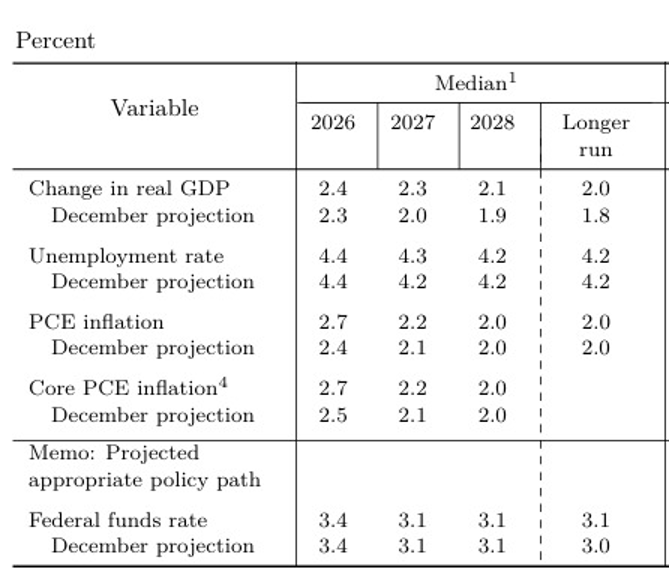
The Federal Reserve decided to keep its benchmark interest rate unchanged within a range of 3.5%–3.75%, amid persistent inflation, mixed signals from the labor market, and rising geopolitical tensions.

While projections point to solid economic growth and a gradual moderation in inflation, higher oil prices and uncertainty related to the conflict in the Middle East have reduced expectations for near-term rate cuts. Policymakers continue to signal a cautious stance, with gradual adjustments expected over the coming years.

Analysis

The current environment reinforces central banks’ data-dependent approach and highlights the importance of external factors such as energy prices and geopolitical risks. Limited visibility on rate cuts could keep financial conditions restrictive for longer.

Market context

The Federal Reserve’s decision to keep rates unchanged reflects a complex balance between inflation dynamics, economic growth, and external risks. Rising oil prices and geopolitical uncertainty have reduced expectations for near-term rate cuts.

In this environment, monetary policy will remain highly data-dependent and shaped by global developments. This reinforces the importance of maintaining discipline, diversification, and a long-term strategic approach in portfolio construction.

Economic projections

Economic Projections of Federal Reserve Members

Source: Federal Reserve

Ponte en contacto con nosotros

Receive the best financial market news

Cookie Policy

We use our own and third party cookies to improve our services and show you advertising related to your preferences, by analyzing your browsing habits. By continuing, you confirm that you have read and accept this policy.