Uriel Loredo

The Fed Enters a New Phase  

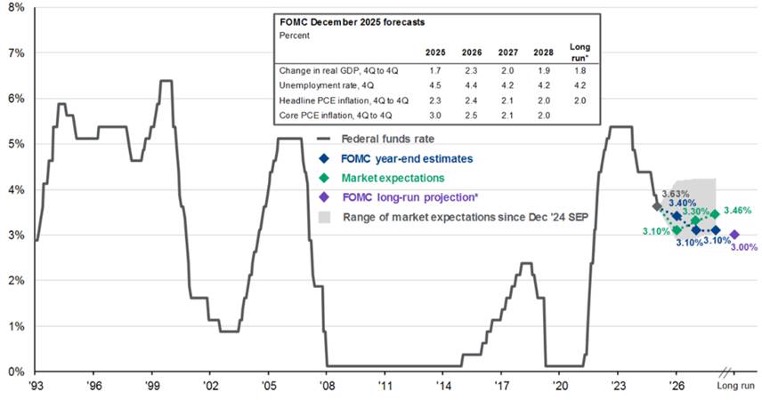
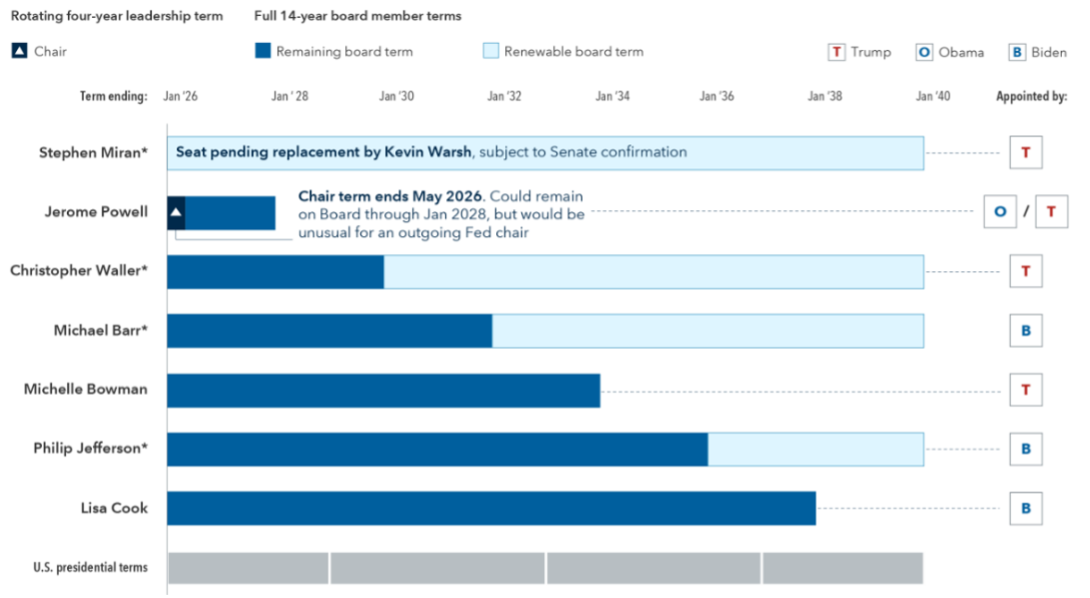
The nomination of Kevin Warsh as the next Chair of the Federal Reserve marks an inflection point for U.S. monetary policy. While he has recently signaled a more pro–lower rates stance, his track record points to a pragmatic, data-dependent approach.

Economic context

With a softening labor market, inflation still above target, and a politically sensitive backdrop, the Fed faces complex decisions. Current signals suggest rate cuts will continue gradually, guided more by economic fundamentals than political pressure.

Market implications

A change in Fed leadership does not automatically imply a loss of independence. Even with a potentially more flexible stance, investors should maintain a long-term investment mindset focused on value creation across market cycles.

Volatility is likely to remain a relevant factor if markets perceive deviations from the Fed’s traditional mandate. This is an environment that calls for careful analysis and a long-term perspective from investors.

Source: Capital Group, Brookings, Federal Reserve
Mixed signals in employment, inflation, and global activity 

The week delivered mixed signals: strong corporate earnings resilience in the U.S., moderating inflation in Europe, and some slowdown across parts of LatAm, while Asia shows early signs of stabilization in industrial activity.

United States

Private job growth slowed, but manufacturing and services remain resilient. Earnings season remains strong, with 80% of companies beating estimates and earnings growing 15% year over year.

Europe

The ECB held rates steady as inflation continues to moderate. Germany posted an industrial rebound, while the BoE showed internal divisions on the rate path.

Japan

Manufacturing returned to expansion after several months of contraction, and services reached their highest level in nearly a year, signaling a gradual recovery in activity.

China

Manufacturing strengthened on higher external demand and production, supporting factory hiring and suggesting stabilization in the industrial cycle.

Argentina

A new agreement with the U.S. on critical minerals aims to accelerate investment and exports, following a record year for the mining sector.

Brazil

Private-sector activity stalled as manufacturing weakness offset services growth, weighing on employment and increasing input costs.

Mexico

Banxico paused rate cuts amid persistent inflation. Remittances declined after record years, and manufacturing remains weak due to tariffs and softer external demand.

“Most people get interested in stocks when everyone else is. The time to get interested is when no one else is.” – Warren Buffett

Key upcoming events

  • In the United States, the Nonfarm Payrolls report will be released on 02/11
  • In the United States, the Inflation report will be released on 02/13

Monitor

Is Bitcoin the Future? A Critical View 

Although Bitcoin was pioneering and revolutionary, its role as the foundation of a global financial system reveals key limitations that merit careful consideration.

Structural limitations

Bitcoin by its nature is limited to only 21 million coins. If we were able to mine them faster (quantum computing, I’m looking at you) or we run out (2150’s according to latest estimates), we will experience a crash akin to the silver boom of the 1850’s or the gold scarcity of the early 1900’s. This is giving away a powerful stabilization tool, i.e. monetary policy, to the quickness of mining. Relying on an external force to underpin global stability ends in catastrophe.

While the narrative of decentralized freedom of the individual against corrupt forces trying to control the world is a great story, life is more nuanced than that and underpinning the stability of the world’s economy to the mining and availability of bitcoin seems foolhardy to me. If bitcoin is cash and cash is bitcoin, any loss of bitcoin will mean a permanent loss of cash. So if someone were to mistakenly discard a hard drive, all of us collectively would have to live with less money. That is a problem, specially given our expansionary economies.

This is only highlighting a narrow issue. You have to also take into account the externalities of such a system, one of them being energy consumption in a world that is now hungrier than ever before for power, and many others which are outside the scope of this post.

The real future of cryptocurrencies

I believe in a not too distant future we will use the full benefits of crypto, decentralized ledgers, tokenization, smart contracts, and frictionless flows of capital. But I don’t think we will do it with bitcoin.

All throughout history humanity has tended to favour standardization and liquidity as they are more efficient over any other concerns when dealing with our methods of exchange for goods and services. The fungibility of gold nuggets (and its wide availability spread almost evenly worldwide) made it outcompete barter. These nuggets which in turn were displaced with coins, which were displaced by notes backed with that gold, which were displaced by debt backed by those notes backed by gold until we got to where we are today, where the exchange of services is backed by debt underpinned in trust.

To many people, the underpinning of the global economy in trust is a crazy idea born out of the lunacy derived from the Bretton Woods system, and it is true that our current economic model was partially developed at that conference. However, the idea is much older than that—about 1700 years old in fact.

Is it true that fiat money is backed by nothing? Correct, as its backing is not a tangible thing but an intangible one: trust. The world economy is fuelled by debt, which is a promise of deferred consumption in exchange for a future greater payment.

The real revolution

The big change I see derived from the crypto breakthrough is that trust can now be decentralized and assigned on an individual basis to anything and everyone around us. So in the future I could buy a car A using Z crypto which the dealer can convert to coin Y directly without having to rely on intermediaries or governments. This system will be backed both by the asset itself and the underlying expansionary coins we develop, which will be a mix of trust and asset backed.

Ironically, this would make the whole system pretty much a barter-based economy but with the fungibility, standardization, and liquidity of our current system.

In my opinion, crypto will be the foundation of our future method of exchange of goods and services, but it won’t be bitcoin.

Would love to hear your thoughts—why you think I’m right or why you think I’m wrong.

Source: Daniel Sánchez

Global outlook: inflation, growth, and trade 

Global markets reflect a balance between solid growth in developed economies, persistent inflationary pressures in certain sectors, and ongoing monetary policy adjustments in emerging markets.

United States

The Fed kept rates at 3.5%–3.75% amid solid growth and stable employment. PPI rose 0.5% month on month, and the trade deficit widened in November, potentially weighing on Q4 GDP.

Europe

Eurozone GDP grew 1.3% YoY in Q4 2025, exceeding expectations. Germany expanded 0.4% YoY, with inflation rising due to food prices, while services inflation eased and consumer confidence improved.

Japan

Service-sector prices rose 2.6% YoY in December. Labor shortages and a weaker yen are pushing costs higher, reinforcing the BoJ’s case for continued monetary policy normalization.

China

The government will prioritize domestic consumption of goods and services in 2026 to reduce industrial overcapacity and external dependence, supporting sectors such as tourism, transportation, and digital services.

Argentina

The IMF reaffirmed a 4% growth outlook for Argentina in 2026 and 2027. Globally, it projects 3.3% growth, conditioned by trade tensions, technology investment, and political uncertainty.

Brazil

Brazil’s Central Bank kept its policy rate at 15.00%. A prolonged pause is expected amid risks from services inflation and FX volatility, with the goal of converging to the 3.2% inflation target by 2027.

Mexico

Mexico’s economy grew 0.7% in 2025, beating expectations. Exports rose 7.6%, driven by non-automotive manufacturing. Unemployment ended the year at 2.4%, and Banxico is considering gradual rate cuts.

Key upcoming events 

  • In the United States, the Manufacturing Purchasing Managers’ Index (PMI) will be released on 02/02 
  • In the United States, the Nonfarm Payrolls report will be released on 02/06 

“Waiting helps you as an investor and a lot of people just can’t stand to wait.” – Charlie Munger 

Monitor

The Fed Pauses Rate Cuts Amid Resilience Signals 

The Federal Reserve kept its benchmark interest rate unchanged at 3.5%–3.75%, signaling a more optimistic view of the U.S. economy. The statement highlighted solid economic growth and early signs of stabilization in the unemployment rate, reducing the urgency for near-term rate cuts. 

While two members voted in favor of a reduction, the majority opted for caution amid persistent inflation pressures and a resilient labor market. The decision reinforces the Fed’s data-dependent approach to monetary policy. 

Market Implications 

Policymakers are balancing inflation control with labor market stability, avoiding premature easing. For markets, this points to a near-term period of stable rates, with the possibility of renewed cuts later in the year if inflation continues to cool. 

The tone of the statement suggests less urgency for near-term rate cuts, as policymakers continue to monitor inflation and employment trends. Key takeaway: caution, data dependence, and the potential for policy adjustments later in 2026 if conditions allow. 

Source: JP Morgan.

Global outlook: growth and inflation in focus 

Global markets reflect a balance between resilient growth, easing inflation in some regions, and persistent pressures in others, shaping monetary policy expectations and economic activity in 2025. 

United States 

Q3 GDP was revised up to a 4.4% annualized rate, driven by exports, business investment, and strong consumer spending. The Federal Reserve is expected to keep rates at 3.50%–3.75% this quarter, reflecting a cautious stance amid mixed economic data. 

Europe 

Eurozone inflation closed 2025 at 1.9%, below the European Central Bank’s 2% target. Germany’s economic confidence improved after several difficult quarters, while the United Kingdom continues to face persistent inflation pressures that complicate monetary policy decisions. 

Japan 

Inflation eased to 2.1% year over year in December. Lower energy prices offset underlying pressures, although core inflation remains above the Bank of Japan’s target, maintaining uncertainty about future monetary adjustments. 

China 

GDP grew 4.5% in the fourth quarter, weighed down significantly by the real estate sector. Weak consumption contrasts with a late-year rebound in industrial production, reflecting an uneven economic landscape that requires targeted stimulus measures.

Argentina 

Economic activity fell 0.3% year over year in November, its first contraction in 14 months, despite solid performance in agriculture and mining sectors. The economy shows signs of weakness in other key sectors. 

Brazil 

Business confidence improved slightly but remains in pessimistic territory. Concerns persist about the pace of the domestic economic recovery, with worries about sustained medium-term growth. 

Mexico 

Inflation rose in the first half of the year, while consumption remained strong, supported by higher retail sales and e-commerce growth. The consumer dynamics contrast with moderation in other economic indicators. 

Key upcoming events 

  • In the United States, the FED monetary policy decision will be announced on January 28 
  • In the United States, the Producer Price Index (PPI) will be released on January 30 

“The big money is not in the buying and selling, but in the waiting.” – Charlie Munger 

Monitor

The Peace Dividend Is Over: Rethinking Defense in Portfolios 

The peace dividend many of us were born into has expired.

We’re entering a new geopolitical reality—one where defense investment can no longer be ignored, even in the most ethically constrained portfolios. Whether you’re in a public pension, a family office, or a university endowment, the relevance of defense—both from a return and a risk management perspective—is rising fast. The question is no longer if you should think about defense exposure, but how you approach it.

Context: A New Strategic Normal

In my early days working at a pension fund, defense exposure was marginal—both in scale and scrutiny. But at Axxets today, that conversation is shifting.

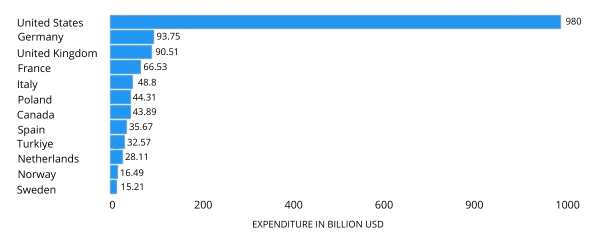
The war in Ukraine, tensions in the South China Sea, and increasing cyber threats have created a multipolar environment with fragmented alliances and local conflicts. These aren’t isolated skirmishes—they represent a structural shift. Defense spending is no longer cyclical; it’s foundational.

This shift is being echoed across markets:

  • Anduril in the U.S. is pushing forward dual-use defense tech that sits at the edge of AI and autonomy.
  • Rheinmetall is playing a growing role as Europe seeks defense sovereignty.
  • Turkey’s defense industry has become a powerhouse in drone and missile development.
  • Even Nigeria is stepping up as ECOWAS’s security guarantor—something unthinkable a decade ago.

This isn’t just about legacy players like Lockheed or Raytheon anymore. The industry is evolving—and fast.

Insight #1: Defense as Strategic Infrastructure

One lesson we’ve learned is that defense is increasingly analogous to energy or cybersecurity—a non-optional sector underpinning state functionality. For many regions, it’s also an employment engine and a source of technology spillovers.

While traditional defense primes are still important, we’re seeing compelling innovation at the intersection of software, AI, and autonomy. These startups—and the venture capital flowing into them—are modernizing the defense sector with scalable, modular solutions that can support both military and civilian uses.

For allocators, this means the entry points are no longer limited to defense ETFs or legacy primes. Private capital is playing an increasingly important role in shaping the industry’s next chapter.

Insight #2: Valuations and Volatility Are Real

The reality is more nuanced than “defense is back.” High valuations—often pushing P/E ratios near 40x—aren’t uncommon. Much like in AI, investors must be selective and realistic about what’s already priced in.

Add to that policy risk and export restrictions, and you’ve got a highly reactive asset class. For example, a shift in U.S. foreign policy can cancel contracts overnight.

In practice, this means we focus on:

  • Dual-use technologies with civilian applications.
  • Localized players with government backing and cost advantages.
  • Suppliers in NATO-adjacent markets adapting to new procurement frameworks.

Being thoughtful here isn’t just ethical—it’s also practical portfolio construction.

Insight #3: Ethics, Exposure, and the Investment Dilemma

At Axxets, we’ve had internal debates on how to incorporate defense. It’s a conversation that balances fiduciary responsibility with family values.

Defense investing isn’t binary.

It can include supply chain tech, cybersecurity, drone navigation, AI systems, and encrypted communication platforms—each sitting on a spectrum from commercial to military use.

That said, not investing in the sector is also a choice—with its own trade-offs. Ignoring the conversation entirely risks missing exposure to a sector reshaping global power dynamics and, by extension, markets.

Final Thought: Don’t Skip the Conversation

Defense is no longer a niche or optional allocation. Whether your conclusion is to invest or to consciously exclude it on ethical grounds, the conversation must be had.

Because in a world where geopolitics directly shapes returns, sitting on the sidelines is itself a decision—one that should be made thoughtfully, not passively.

What role does defense play in your portfolio today? Is it time to revisit that assumption?

Source: STATISTA

Mixed outlook between inflation and growth 

Key data on inflation, consumption, and growth shape the start of 2026 

This week, markets reacted to mixed signals: stable U.S. inflation, positive surprises in retail sales, and uneven growth across Europe. Meanwhile, China strengthened its global trade presence, and Argentina closed the year with its lowest inflation in eight years. 

United States 

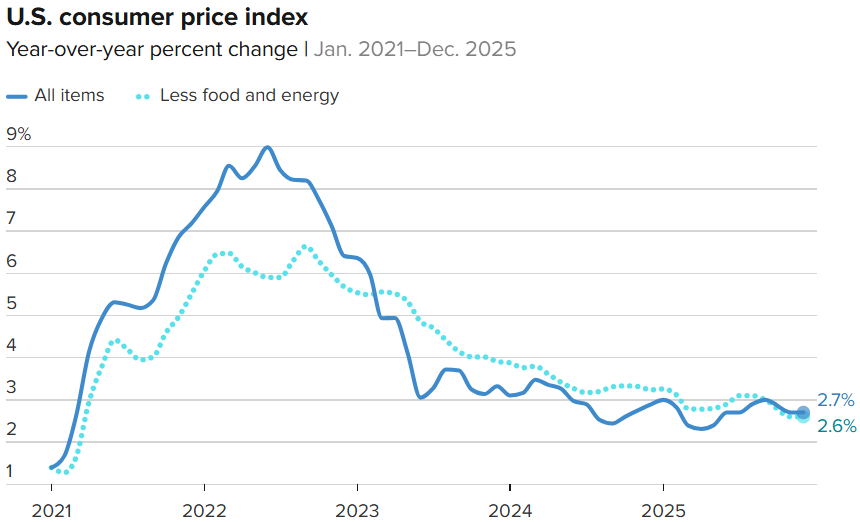
Headline inflation held at 2.7% and core inflation at 2.6%. PPI rebounded to 3% due to energy. Retail sales rose 0.6%, pointing to a segmented consumption pattern. Projected GDP was revised to 5.1%. The earnings season begins with positive results from banks. 

Europe 

Germany exits recession with 0.2% annual growth, though industrial activity remains weak. The United Kingdom surprised with 1.4% annual growth. Trade association BGA expects a modest recovery in Germany’s wholesale sector in 2026. 

Japan 

The prime minister will dissolve Parliament and call early elections. The Producer Price Index fell to 2.4% year over year in December, the lowest level since May, in line with expectations. 

China 

Posted a record trade surplus of $1.19 trillion in 2025. The decline in exports to the U.S. was offset by strong growth in shipments to Africa and Asia. 

Argentina 

Inflation closed the year at 31.5%, its lowest level since 2017. In December, prices rose 2.8%, driven by transportation, housing, and food. 

Brazil 

Retail sales increased 1.3% year over year in November. While positive, they remain below the historical average. 

Mexico 

The World Bank lowered its 2026 growth forecast to 1.3%. Fixed investment fell 5.5% year over year in October, although residential construction grew 13.5%. 

Key upcoming events 

  • United States: markets will be closed for the Martin Luther King Jr. Holiday 01/19 
  • United States: the final reading of Q3 GDP growth will be released on 01/22 

“The stock market is a device for transferring money from the impatient to the patient.” – Warren Buffett

Monitor

U.S. core inflation cools further 

U.S. core inflation came in softer than expected in December, reinforcing the view that underlying price pressures are gradually easing. Core CPI rose just 0.2% month over month and 2.6% year over year, both below consensus, pointing to a continued normalization of inflation dynamics. Still, headline inflation remains at 2.7%, meaning price stability has not yet been fully restored.

What’s holding the Fed back is the composition of inflation. Housing costs, more than a third of CPI, continue to rise at an elevated pace, while services, recreation, and airfares remain sticky. Even as some goods show deflation, the Fed is still waiting for economic data and assessing the effects of previous cuts, limiting the case for near-term rate cuts. Markets now expect the Fed to remain on hold at least through the first half of the year.

Market Implications

  • It reinforces the scenario of inflation slowing down, but too slowly to justify immediate interest rate cuts.
  • Risks in the housing and services sectors reduce the likelihood of an accelerated monetary stimulus cycle.
  • Makes upcoming inflation and labor data critical for market direction.

Source: CNBC with information from U.S. Bureau of Labor Statistics

Global Economic Outlook: Mixed Signals 

In a relatively calm week, employment and consumption indicators provided key signals across major economies. Central bank decisions continue to reflect a cautious, data – dependent approach, while global economies show divergences between production and consumption that reinforce the need for selective analysis heading into 2025.

United States 

  • Nonfarm payrolls exceeded expectations, adding 64,000 jobs in November. 
  • The unemployment rate rose to 4.6%. 
  • Headline inflation eased to 2.7% and core inflation to 2.6%. 

Europe 

  • The ECB held rates at 2.15% and revised its growth outlook. 
  • Eurozone inflation stood at 2.1%. 
  • Germany and Spain recorded 2.6% and 3.2%, respectively. 
  • The United Kingdom cut its policy rate to 3.75%. 

China 

  • Industrial production grew 4.8% year over year in November. 
  • Retail sales rose just 1.3%, the weakest increase since December 2022. 
  • Sharp declines in automobiles, household appliances, and construction materials. 

Argentina 

  • GDP expanded 3.3% year over year in 3Q, below expectations. 
  • Manufacturing output declined 2.4%. 
  • The unemployment rate fell to 6.6%, approaching historical lows. 

Brazil 

  • Economic activity declined 0.2% month over month. 
  • Agriculture helped prevent a deeper contraction. 
  • The central bank revised its GDP growth forecast upward and maintained a restrictive stance to contain inflation. 

Mexico 

  • Banxico cut its policy rate to 7%. 
  • Retail sales increased 3.4% year over year, driven by strong online sales. 
  • Employment in the sector rose 1%, while wages increased 3.3%. 

“The first rule of compounding: Never interrupt it unnecessarily.” — Charlie Munger 

Key Upcoming Events 

  • United States: Quarterly GDP growth release — December 23 
  • United States: Labor market data release — December 24 

Monitor 

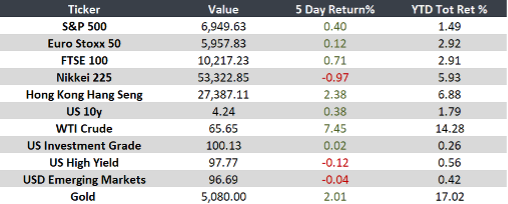
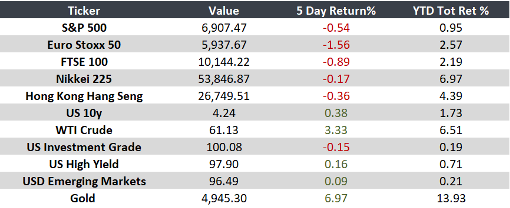
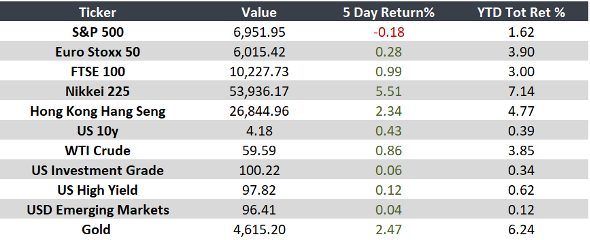
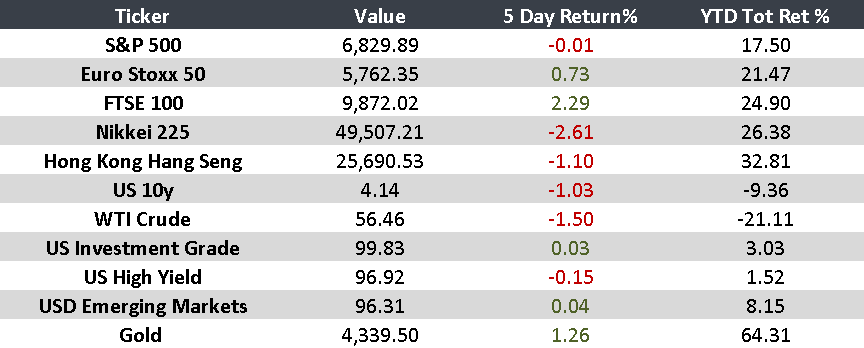
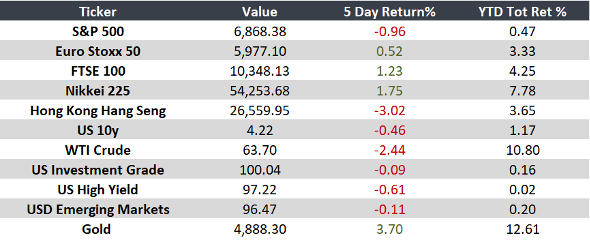
Returns as of 10 AM EST 

Ponte en contacto con nosotros

Receive the best financial market news

Cookie Policy

We use our own and third party cookies to improve our services and show you advertising related to your preferences, by analyzing your browsing habits. By continuing, you confirm that you have read and accept this policy.