Uriel Loredo

Fed splits opinions and key data ahead 

Markets reacted to the Federal Reserve’s latest rate cut amid a set of mixed signals on inflation, production, and employment across major economies. The week was shaped by U.S. labor data, an industrial rebound in Europe, and contrasting dynamics in Asia and Latin America, reinforcing a cautious outlook for monetary policy heading into 2026. 

United States 

  • The Fed cut rates to a range of 3.50%–3.75%, with three dissenting votes. 
  • Policymakers signaled only one additional adjustment in 2026. 
  • Labor cost growth moderated. 
  • Job openings remained stable, pointing to easing wage pressures. 

Europe (Germany) 

  • Industrial production rose 1.8% in October, the strongest increase since March. 
  • Growth was driven by machinery and electronics. 
  • Exports increased 0.1%, supported by intra-EU trade, despite weaker shipments to the U.S. and China. 

Japan 

  • Producer prices rose 2.7% year over year in November, unchanged from the previous month. 
  • The strongest increases were seen in nonferrous metals and food & beverages. 

China 

  • Annual inflation rebounded to 0.7%, the highest level since February. 
  • Food prices rose for the first time in ten months. 
  • Producer prices fell 2.2%, extending a 38-month contraction amid weak domestic demand. 

Brazil 

  • Annual inflation declined to 4.46%, its lowest level since September 2024. 
  • The Central Bank held its policy rate at 15.00%. 
  • Authorities signaled a prolonged pause to ensure convergence toward the inflation target. 

Mexico 

  • Inflation rose to 3.80% year over year, the highest reading since June. 
  • Auto production fell 8.4% year over year in November. 
  • Year-to-date, production is down 1.5%. 

“The single greatest edge an investor can have is a long-term orientation.” 
— Seth Klarman 

Key Upcoming Events 

  • United States: Nonfarm payrolls report — December 16 
  • United States: November inflation report — December 18 

Monitor 
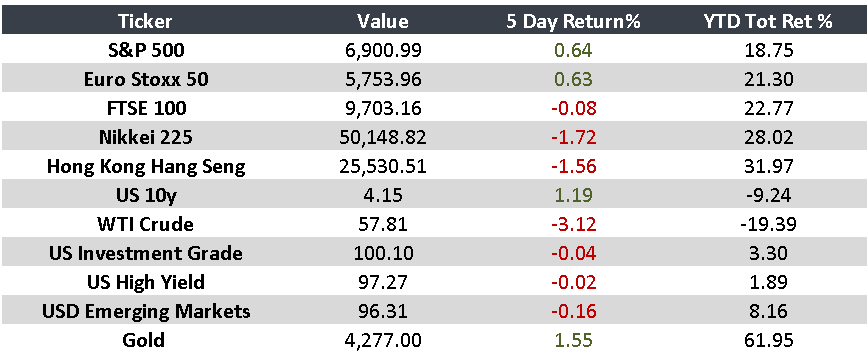
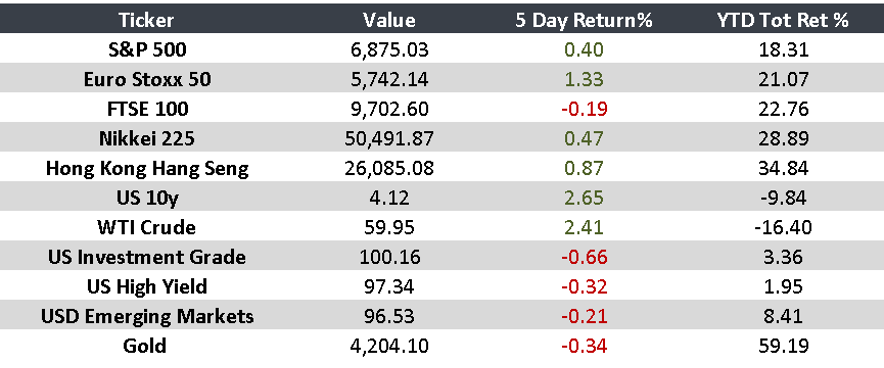
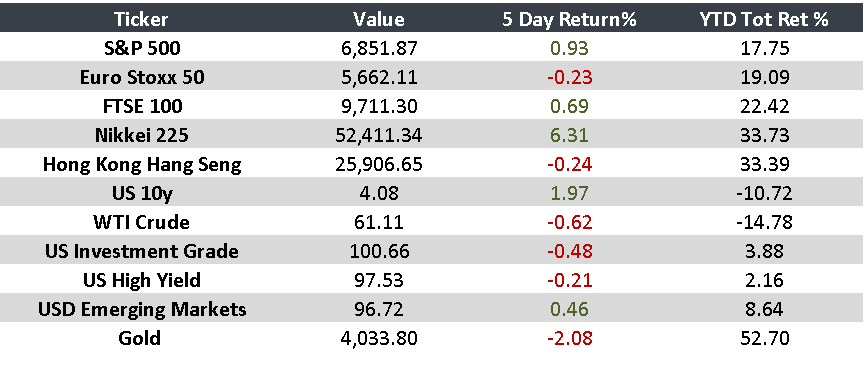
Returns as of market close on December 11. 
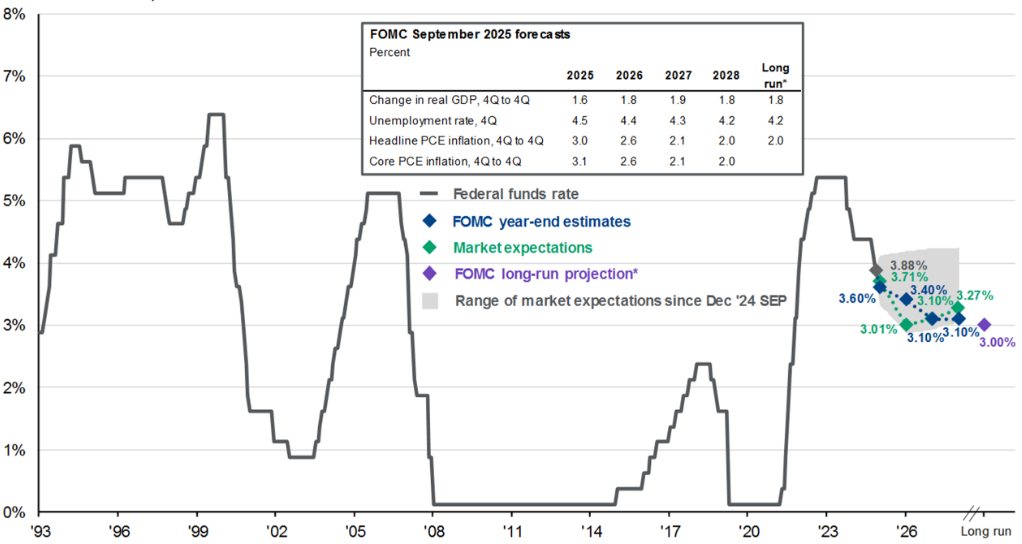
Fed: Mixed Signals After the Latest Rate Cut

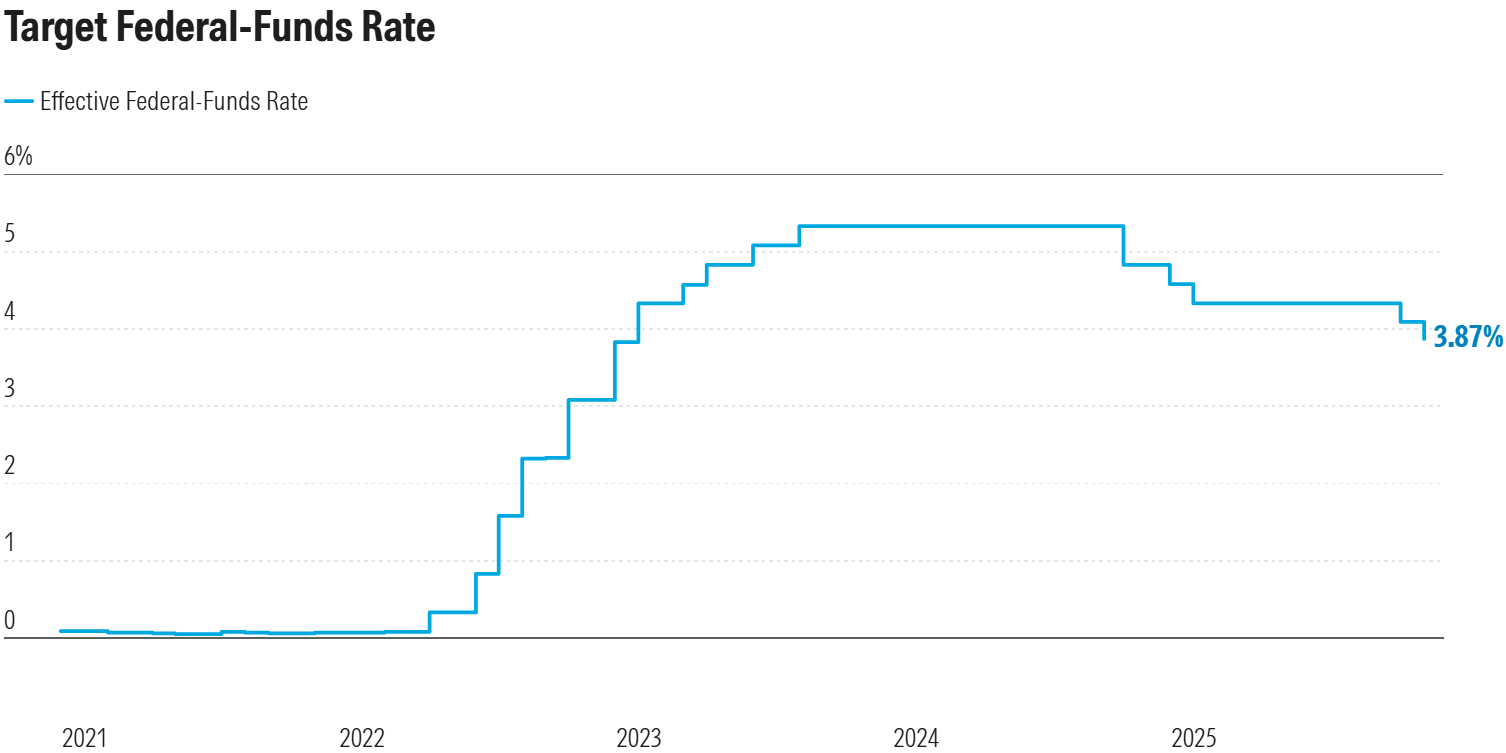
The Federal Reserve delivered its third consecutive rate cut, lowering the federal funds rate to a range of 3.50%–3.75%. While the move was widely anticipated, the accompanying statement revealed rising uncertainty about the policy path ahead. The committee showed an unusual split between members focused on labor-market weakness and those still concerned about persistent inflation pressures.

The updated dot plot, which reflects policymakers’ rate expectations, pointed to just one additional cut in 2026 and another in 2027. Although the projected path remained unchanged, it underscored diverging views within the committee regarding the appropriate level of interest rates over the medium term.

The latest rate cut confirms that the Fed maintains an accommodative bias, but the internal divisions suggest that the pace of future adjustments is likely to slow. In this environment, markets are expected to remain highly sensitive to incoming employment, inflation, and monetary policy expectation data throughout 2026.

Source: JP Morgan

Mixed signals: weak manufacturing, moderating labor data, and rising expectations of rate cuts 

Markets ended the week focused on the persistent weakness in global manufacturing activity and the continued loss of momentum in the U.S. labor market. In this environment, expectations for a potential interest rate cut before year-end strengthened. Europe and Asia showed mixed signals, while Latin America posted contrasting results across growth and income indicators. 

United States: 

  • Manufacturing contracted for the ninth consecutive month, while the services sector recorded its strongest expansion in nine months. 
  • Private employers cut 32,000 jobs, reinforcing expectations of a December rate cut, now priced with an 87% probability. 

Europe: 

  • The Bank of England reduced capital requirements for the first time since 2008 in an effort to stimulate lending. 
  • Eurozone inflation reached 2.2% year over year, with services remaining the main driver. 

Japan: 

  • The services sector maintained a solid pace of expansion in November, supported by rising new orders and improved business confidence. 

China: 

  • Manufacturing contracted for the eighth straight month, while services grew at their slowest pace in five months. 
  • Analysts expect additional expansionary measures to help sustain a growth target near 5% in 2026. 

Brazil: 

  • GDP grew 1.8% year over year in 3Q25, its weakest reading since 2022. 
  • Agriculture and industry remained the main contributors despite the slowdown. 

Mexico: 

  • Remittances fell 1.7% year over year in October, marking the smallest decline since April. 
  • The minimum wage will increase 13% in 2026 to 315.04 pesos per day, a cumulative rise of 150% since 2018. 

“Risk comes from not knowing what you’re doing.” — Warren Buffett 

Key Upcoming Events: 

  • United States: Employment data release — Dec 9 
  • United States: Federal Reserve monetary policy announcement — Dec 10 

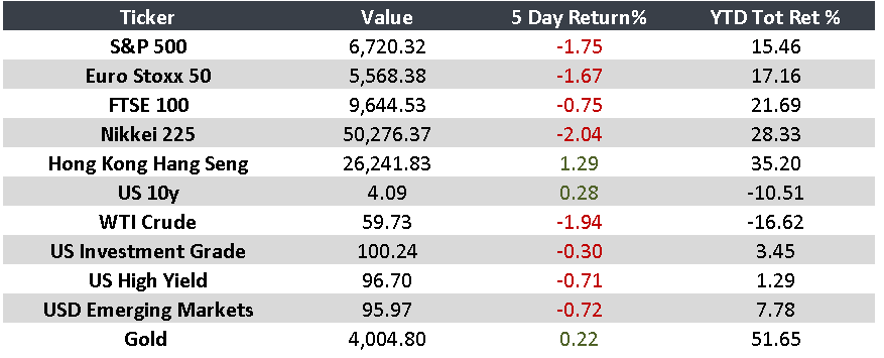
Monitor

Is the Santa Claus Rally real?

A seasonal rally or just a myth? 

The “Santa Claus Rally” describes a historical pattern: markets tend to rise during the final days of December and early January. We analyze its consistency and what to expect heading into 2025. 

In the financial world, the “Santa Claus Rally” describes a historical pattern: markets tend to rise during the last five trading days of December and the first two of January. According to the Stock Trader’s Almanac, this phenomenon has occurred approximately 78%–80% of the time since 1972, with an average return of 1.3% to 1.4% for the S&P 500. 

Possible reasons range from lower trading volume as many institutional investors take time off, to a more optimistic emotional tone driven by the holidays, year-end bonuses, and portfolio adjustments like rebalancing or tax-loss harvesting. 

However, it doesn’t always happen. Over the past decade, the effect has been weaker, with average returns around 0.38%. Factors like inflation, elevated rates, geopolitical tensions, or economic surprises have completely negated this seasonal boost. 

Key Takeaways: 
✓ While the Santa Claus Rally has shown historical consistency, factors like elevated rates, inflation, and volatility limit its reliability as a strategy. If it happens, view it as an extra boost—not a basis for decision-making. 
 
✓ The Santa Claus Rally refers to the market uptick during the last five trading days of December and the first two trading days of January. 

Stablecoins: Innovation or silent threat to money?

Stablecoins pose a structural challenge to global monetary policy, potentially driving persistent inflation above central bank targets. Central banks don’t regulate or control stablecoin issuance, limiting their ability to adjust money supply across economic cycles. While currently backed 1:1 by fiat, a shift to fractional reserves could amplify inflation. 24/7 DeFi transactions accelerate monetary velocity, amplifying liquidity and inflationary pressures. Stablecoin-backed DeFi lending creates excessive leverage, risking bubbles that affect both crypto ecosystems and real-world assets. 

Key data: 

  • Stablecoins monetize otherwise immobilized assets (dollars, Treasuries) 
  • 24/7 transactions outside central bank control 
  • Long-term rates could reach ~3.5% 
  • 150 basis points above the past decade 

Stablecoins aren’t just redefining global liquidity; they’re silently expanding the foundation for structural inflation. Combined with demographics, energy transition, and deglobalization, they drive structural inflation, affecting monetary policy and asset class returns. 

Jobs, the Fed, and Growth: A Week of Mixed Signals 

The U.S. labor market returned to the spotlight this week, while Europe maintained a stable tone and Japan showed signs of cooling. In Mexico, foreign direct investment continued to strengthen. Here are the key topics to watch. 

United States: 

• The economy added 119,000 jobs in September, above expectations, although the unemployment rate rose to 4.4%. 
• The Fed remains divided, and the probability of a December rate cut currently stands at 40%. 

Europe: 

• Inflation remains stable near 2%, and the ECB is expected to keep rates unchanged at least through the end of 2026. 
• In the UK, inflation fell to 3.6%, potentially opening the door for a rate cut by the Bank of England in December. 

Japan: 

• GDP fell 1.8% annualized in the third quarter, with a quarterly contraction of 0.4%. 
• Exports were the main drag, reflecting a weaker external backdrop. 

China: 

• For the sixth consecutive month, the central bank kept its benchmark lending rates unchanged. 
• The decision was in line with expectations as the economy seeks stability amid domestic challenges. 

Mexico: 

• FDI grew 14.5% year-over-year from January to September, surpassing $40 billion. 
• Economic activity showed no change in October, both month-over-month and compared with the same month in 2024. 

“Be fearful when others are greedy and greedy only when others are fearful.” — Warren Buffett 

Key Upcoming Events: 

• U.S.: Beige Book release — 11/26 
• U.S.: Thanksgiving Day (market holiday) — 11/27 

Monitor

Stablecoins: The Hidden Key Piece Driving Interest Rates and Global Liquidity

Stablecoins are no longer a theoretical exercise but have become part of the global financial market. With a capitalization exceeding $200 billion and high growth, their impact on the global economy is undeniable. Despite this, they remain excluded from monetary indicators like the M2 Money Supply. This omission is, in our opinion, a technical legacy that must soon be corrected. 

Stablecoins meet all M2 criteria: near-immediate liquidity, backing by fiat money like USD, and transactional use. They function as a new layer of private global money, operating in parallel to the traditional system. These assets monetize immobilized assets (like Treasury bonds), increasing the effective monetary base without central bank intervention. 

Key Data Points: 

  • Capitalization exceeds $200 billion. 
  • Meet all M2 criteria (liquidity, fiat backing, transactional use). 
  • They monetize Treasury bonds, increasing the effective monetary base. 
  • Their exclusion may imply recognizing higher inflation. 

Institutional resistance to including them in official statistics is not due to a lack of merit, but structural inertia and a possible political dilemma. The expansion of stablecoins represents an evolution in monetary architecture. Ignoring them is a risk; incorporating them into M2 is a necessity. 

A divided Fed: what’s next for the markets?

The Federal Reserve has not reached a clear agreement on its next steps. 

A few weeks ago, the Fed cut its rate by 25 bps, but the real surprise came from the vote: one member called for a deeper cut, while another preferred none at all. 
Two opposing positions that reveal an important fact: the economy is sending mixed signals

In this scenario, Jerome Powell was clear: a December cut is not guaranteed. 
Rather than dysfunction, this division shows that the path ahead remains uncertain. 
Why is the Fed divided? Because economic data continue to send conflicting and inconsistent signals

Key points: 
☑ Stock market at record highs 
☑ Accelerating investment in AI 
☑ Resilient consumer spending 
☑ Labor market losing momentum 
☑ Housing sector stagnating 
☑ Rising layoffs and credit card delinquencies 
☑ Government shutdown delaying key data, reducing visibility for both the Fed and the markets 

A divided Fed doesn’t imply chaos, but rather caution in the face of an ambiguous economy and incomplete data

The message for investors is clear: it’s not about predicting the next move, but about staying disciplined and focused on long-term horizons

Source: Morningstar 

Week of stable rates and mixed signals in manufacturing

Markets reflected a week of steady interest rates, weaker manufacturing data, and resilience in services. In the United States, the government shutdown remains unresolved, while year-end spending shows a more moderate tone compared with 2024. 

United States: 
Concerns over AI valuations drove market sentiment. Manufacturing activity declined, but the services sector rebounded. The government shutdown set a new record, and year-end spending is expected to moderate. 

Europe: 
Eurozone manufacturing stalled due to a lack of new orders, although production continued to grow. The Bank of England kept its policy rate at 4%, as expected. 

Asia: 
In Japan, manufacturing posted its worst reading in more than a year, pressured by weak demand in autos and semiconductors. The services sector remained resilient despite a slower pace of new orders. 
In China, manufacturing activity fell to its lowest level in six months. Services expanded but at the slowest pace since July, mainly due to weaker export demand. 

Latin America: 
In Brazil, the Central Bank held its key rate at 15%, the highest level since 2006, indicating caution amid persistent inflationary pressures. 
In Mexico, Banco de México cut its policy rate to 7.25%, in line with expectations. September remittances fell 2.7% YoY, though they remain above $5 billion. 

“The investor’s chief problem — and even his worst enemy — is likely to be himself.” — Benjamin Graham 

Important Events: 

  • U.S. October inflation data will be released — November 13 
  • U.S. Producer Price Index (PPI) will be published — November 14 

Monitor

Global Financial Outlook: Fed Cuts Rates and U.S. Extends Tariff Truce with China 

The week was marked by mixed signals in global markets following a series of key events. These included the Federal Reserve’s (Fed) second consecutive policy rate cut, the extension of the tariff truce between the United States and China, the stagnation of the German economy, and the improvement in China’s industrial profits. These developments underscore the complexity of the global economic and trade environment. 

United States: 

  • The Federal Reserve cut the policy rate to a range of 3.75% – 4.00%. 
  • Trump and Xi agreed to extend the tariff truce for one more year. 
  • Consumer confidence fell to its lowest level in six months. 
  • Earnings season continues to show strength, with S&P 500 earnings growing about 10% this quarter. 

Europe

  • The European Central Bank (ECB) kept its key rate at 2%. 
  • Germany’s economy stagnated due to weaker exports and ongoing global trade pressures, despite a slight improvement in business sentiment. 

Japan

  • The government highlighted a moderate recovery supported primarily by capital spending. 
  • Caution persists due to risks linked to U.S. trade policy. 

China:

  • Industrial profits rose 21.6% YoY in September, the fastest pace since November 2023. This reflects better capacity utilization. 

Brazil

  • The U.S. Senate approved a bill to revoke tariffs on Brazil by lifting the national emergency declaration issued in July. 

Mexico:

  • Gross Domestic Product (GDP) contracted 0.3%YoY in 3Q25. 
  • According to President Sheinbaum, the United States extended the negotiation period to avoid the implementation of a 30% tariff. 

“Compound interest is the eighth wonder of the world. He who understands it, earns it; he who doesn’t, pays it.” – Albert Einstein 

Key Upcoming Events 

  • U.S.: ISM Manufacturing – Nov 3. 
  • U.S.: ISM Services & employment-related data (tentative) – Nov 5-7. 

Monitor

Ponte en contacto con nosotros

Receive the best financial market news

Cookie Policy

We use our own and third party cookies to improve our services and show you advertising related to your preferences, by analyzing your browsing habits. By continuing, you confirm that you have read and accept this policy.